Make Me a Mondrian: Corrupted at Last

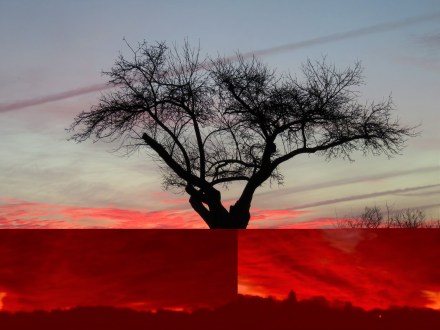
split tree

Picture corrupted.

23,229 times over.

It’s not always easy to identify the dog that did not bark–or, in this case, which digital pictures among a cast of tens of thousands have disappeared and cannot be put together again.

I realized my little yellow bird was gone.  He had flown away into the ether. All that remains is one long-range shot of him warbling into a late spring wind from atop a dogwood dotted with hints of budding lime leaves.

I managed to accidentally erase from my computer every single JPG photo file, including thousands I foolishly–not having adequately absorbed my lesson–had not yet siphoned onto an external hard drive.

Apparently I have an internal “shadow drive,” which was the first attempted excavation site. Nothing. Zip.

Three increasingly desperate and expensive attempts to reconstruct pictures from my camera’s memory card ensued.  To find my little bird friend I ultimately clicked one-by-one through 28,040 files.  But he was among those which have gone, gone away.  Not a single brilliant yellow feather.

The bird’s portraits were among the lost.

But I found in my camera’s jumbled memories some glorious vistas I had never beheld, and which would not exist now but for my egregious mistakes.
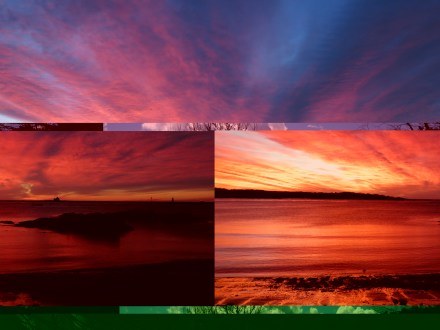
File2078


Like the orange light in between a red “stop” and a green “go,” apparently there is an interim world between a successfully reconstructed image and an irrevocable “no picture available.”

Evidently abhorring a vacuum, shards of partially reconstructed pictures were switched around like puzzle pieces.  It is as if my computer were trying desperately to please me, to assemble fractured images into a whole–an unexpected and bright new reality supplanting the one I hazily remember.  Perhaps it is merely a technological artifact that the breakdowns are more common and surreal as I go back in time through those files.
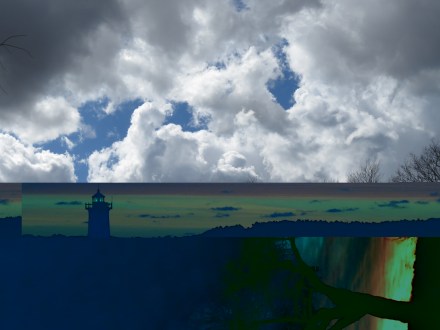
File0331


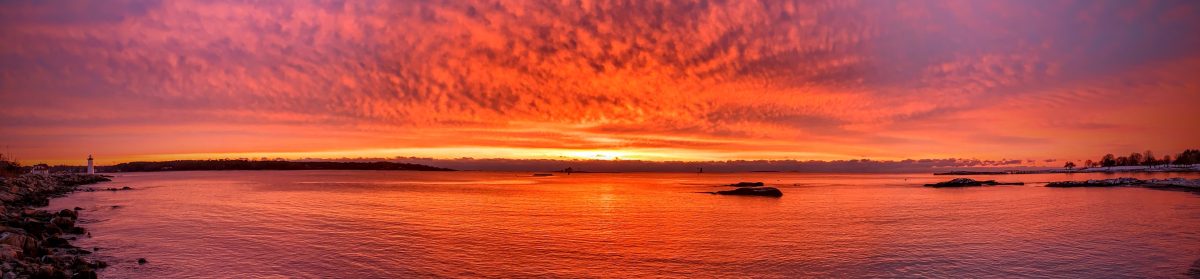
A tree’s roots split off into equal portions of two blazing red sunsets.  Bricks slough off from their landscapes and gather together in walls of intense violet-blue or orange.  Slivers of sea and sky from different seasons are sorted and stacked into a Mondrian… and several Rothkos.  Portions of structures are transformed into neon matte colors, like a Warhol screen print.

Would a sane person have done any of this? Could I perhaps just have gone back to the grassy marsh and hoped to find another little yellow friend?

This jaunty bird was special.  Sometimes I am called–most often by birds–to make detours. Last weekend my subconscious spun me considerably out of my way, towards a stretch of the Atlantic where I’d never set foot.  The weekend before Memorial Day no on else was in sight.  And there he was: a single plump fellow singing out to the rising sun, calling out to his tribe, a lone bright dab of yellow in a tea-dyed marsh.

He’ll remain a sunny blur in my own shadowed memory.
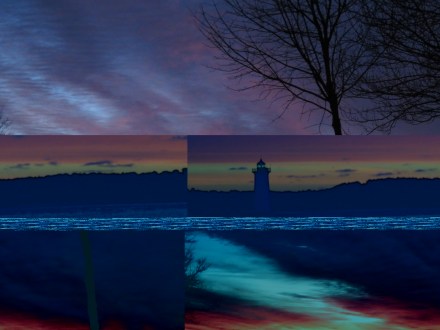
 

File0524


Jubilation in Unlikely Places

singingyellowbird

What does jubilation look like?

Does it look the same to the grieving as it does to those not mired in grief?

Jubilation is different in kind, and not merely in magnitude, from happiness–and happiness itself may seem out-of-reach to those who long for the lost.

(I do not think “jubilation” meant what “Cecilia’s” lover thought it did; in context, he seemed merely to have been besotted by her sporadic company.)

To Frederick Buechner, jubilation was joy, a “dance of unimaginable beauty.” He saw happiness as merely a pale byproduct of “things going our way, which makes it only a forerunner to the unhappiness that inevitably follows when things stop going our way, as in the end they will stop for all of us.”  He points out that the Last Supper was eaten with knowledge of Jesus’ impending death, and as an occasion “was in no sense happy,” but nonetheless was an opportunity for him to express, without irony, “that my joy may be in you” (John 15:11).

Today I saw jubilation in what may seem the unlikeliest of places, including a cemetery where dozens of people gathered around a headstone, linked our hands in a large circle, then looked up to see our earthbound configuration echoed directly overhead in a perfectly round rainbow that lingered until we let go.

227


On my still-healing leg, I walked with a fellow widow whose friend’s family had organized an event honoring a brother who died from pancreatic cancer, the same hideous disease that took my husband from us when he was barely out of his 40s.

One sister had made a wall of photographs selected by people who loved others who had died of cancer.  Each one of of those faces radiantly smiled into a camera, and it was impossible not to smile back at the memories of pure joy captured forever and chosen to introduce our loved ones to people they had never met: one young man cradled the smiling baby son who would turn one just before his father died; another, on a canted surfboard, caught an enormous teal wave; a woman smiled from underneath a wool winter cap; my Jim grinned as he soaked in the sun at an outdoor Richard Thompson concert. (No one other than the two of us could have dreamed he was terminally ill, and his fanny pack contained a continuous infusion of chemotherapy drugs plugged into his implanted port, underneath an orange T-shirt.)

I realized that no grief dwelled in these pictures of those for whom we grieve.

These were pictures of jubilation.  Each face and stance expressed complete joy in a moment, unfiltered by the tears and longing of the living who gathered today, or the weight of their survivors’ memories of their illnesses and pain.

“Joy,” Buechner wrote, “does not come because something is happening or not happening, but every once in a while rises up out of simply being alive, of being part of the terror as well as the fathomless richness of the world…”

During that last outdoor concert before he died, Jim was not thinking one whit about his cruel affliction.  He was feeling the late summer sun’s warmth, enjoying a cold bottle of orange juice, listening in a lawn chair at sunset to one of his favorite performers, playing one of his favorite songs.  He was jubilant.

“You can go with the crazy people in the Crooked House
You can fly away on the Rocket or spin in the Mouse
The Tunnel of Love might amuse you
Noah’s Ark might confuse you
But let me take my chances on the Wall Of Death….”


Earth Tones


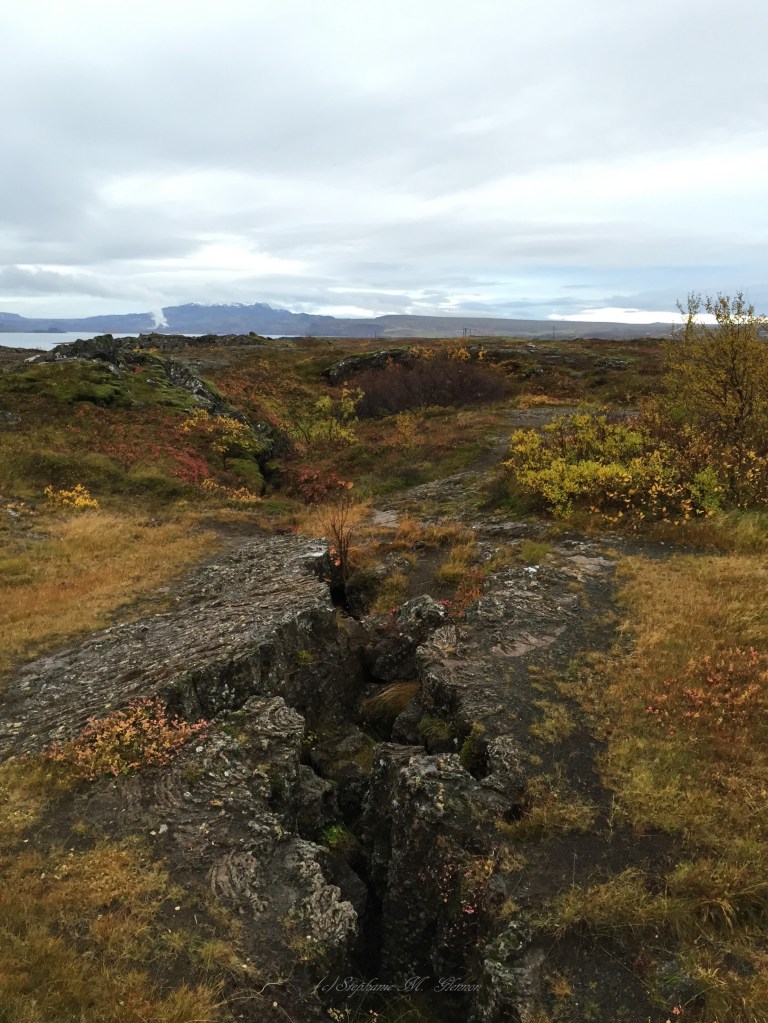
Iceland fall 260

It does not feel anything like being on a mountaintop.

The dark chasm plummets to the ocean floor at the Mid-Atlantic Ridge, where the Earth was riven long before humans arrived.

Although one can stand at Reykjanes Ridge, the vast scarred mountain range remains almost entirely hidden beneath the sea.

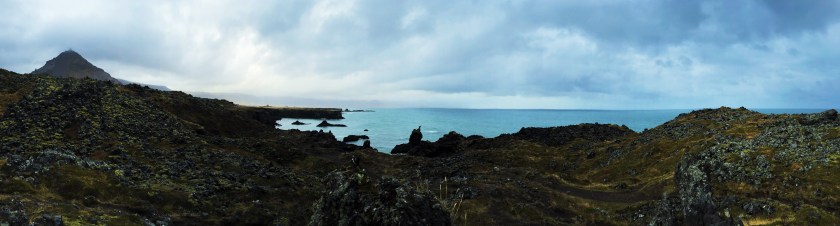
Where I stood in southwestern Iceland, the jagged outline where the earth had parted resembled a raptor rising in flight.  But what truly drew my eye was the surrounding color. Rich russet, sparkling copper, bright lime velvet moss, and honeysuckle grasses swept out to the cerulean sky and sea.

Silver water pooled in boulders’ concentric swirls and rose in distant feathered steam plumes.

At the same spot where the Earth’s vast energy cleaved continental plates, on this still day plants grew yet more imperceptibly than the divide, turning a dusting of light rain into a bright autumnal landscape.

Iceland fall 760


Life Lessons from a Natural-Born Teacher

May flowers 037


My friend Elizabeth has the serene and calming presence of many natural-born educators, and happens to be a teacher.

And, boy, has she taught me.

Still in treatment herself, she knew when to recommend I read “The Last Lecture,” and she knew what additional lessons perhaps only a survivor can truly impart to those suddenly thrust into cancer’s maelstrom.

She helped me wrap my brain around what my husband meant when he said that a terminal diagnosis could be harder on the spouse than the patient.

She and her husband offered up their own hard-earned experience to ease our sudden transition into a world not even doctors–unless they also are patients–understand.

They invited us up to their home for a rollicking last recording session with the Biff Jackson Group, an evening of belly laughs and home-cooked Italian food and an exegesis on the difference between People Who Like Parmesan and People Who Like Roman.

None of us knew that it would be the last night we spent out, enjoying the matchless company of friends.

They came to our home weeks later, as Jim was dying, and brought a table-sized family rolling board on which gnocchi were hand-cut for our youngest daughter while sauces bubbled on the stove to feed gathered family and friends.

May flowers 062

On March 22 of this year, five years to the day after Jim died, Elizabeth spoke about how she has come to appreciate life lived for nearly a decade with cancer.

Give yourselves a gift and read Elizabeth’s own words: “enjoy every moment you have, even the mundane ones. Every moment is an extraordinary gift you have been given. Ordinary is extraordinary. Every ordinary moment is the gift of life.”

May you enjoy every moment of your birthday today, Elizabeth. Each of them is the sum of wonders of love in all its forms.

As I look at the beaded pearls of water bringing light and depth to the brilliant colors of today’s newly bloomed flowers I remember sitting on the wildflower-strewn hill behind our home with you and Judy as you looked forward to your baby’s birth and told us about the friend whose name your daughter would be given–the baby who is now a beautiful young woman about to bring her gifts to college and the world beyond.

Hope and beauty, heartache and love, all part of each salty tear and each drop of rain.