Done and Undusted

Every living and growing thing is a work in progress, as are most inanimate and many unseeable things. Tulip bulbs and time-smoothed rocks. Reflections, both visible and internal. A trip by land or sea or sky. Quilts , from the sketching to the sewing process. Sunrise. Anger. Taste in art and novels. Betrayal and trust, both in the building and in the breach.

Landscapes and visitors to them. Altitude and attitude.

Hope and regret and resignation.

Memories. Love.

Lunch.

Even when something’s done and dusted–including long after I’ve pressed “publish”–everything I write remains a work in progress. When I revisit an old post, or a brief I filed decades ago, I often wince at something that could have been better said.

Each post I’ve made in the past many months has required a scandalous number of revisions–not because of a change in the way I write, but because of changes in me. (Although I suspect that is a chicken-and-egg construct for most people who write).

The writer I am in the moment is never the writer I was in the past. Sometimes, for better and worse, I hardly recognize prose as mine. I’m occasionally pleasantly surprised. (More often, I think, “How could I have missed that mistake when I read my draft aloud . . . four times?”)

Every living and growing thing is a work in progress, as are most inanimate and many unseeable things. Tulip bulbs and time-smoothed rocks. Reflections, both visible and internal. A trip by land or sea or sky. Quilts , from the sketching to the sewing process. Sunrise. Anger. Taste in art and novels. Betrayal and trust, both in the building and in the breach.

The quilts I’ve sewn since I was ten are, by their nature, works in often reductive progress. The better loved a baby quilt, the more it tends to emerge from its recipient’s childhood in a very different and diminished physical state (not unlike its seamstress). It begins and ends in pieces.

The process of handmaking a quilt, followed by a child’s enthusiastic use of it, is like a Riddle of the Sphinx writ in 100% cotton prints. The binding at the quilt’s edges–always the final touch when making it–is almost always the first to go. Its tightly woven threads are worn away by tiny hands grasping it for comfort. Entire brightly-colored applique shapes sometimes follow suit, fading and letting go like petals once they have been loved back to exhausted pieces. The hand-stitched threads that secured them can only take so much love and laundering.

This goes for my photographs, too, in a way. I now take photos in somewhat less absurd quantities than I acquire fabric. My early landscape and seascape photos were . . . not good. I tended to emulate my longtime Deering camp friends’ band motto–“Quality through volume.” But along the way, I grew from sheer practice to be able to frame shots. To catch the ephemeral when it was willing to be caught. To wait patiently, no matter what was buzzing and slithering and stinging nearby . To appreciate what was temporarily in my sight, and that a rushed shot would not enhance my chances of preserving something special.

This morning was summer-steamed, shrouded in deep gray mist. But I thought I spotted a visitor to a darkened house just off a very busy main road. From a distance, I quietly zoomed in and took a single photo.

I may still have work to do, but the fawn posed perfectly before loping away.

I couldn’t have improved on it.

En Guard!

Fences are said to make good neighbors, but they provide many other services, including considerable photographic opportunities. They help keep our beagles from escaping while chasing scents. My husband once forwarded me an account of an undoubtedly well-meaning beagle who was recovered–in Indiana–after more than two years on the lam and 850 miles from his fence-free home. My husband’s header: “I wonder how far the rabbit got?”

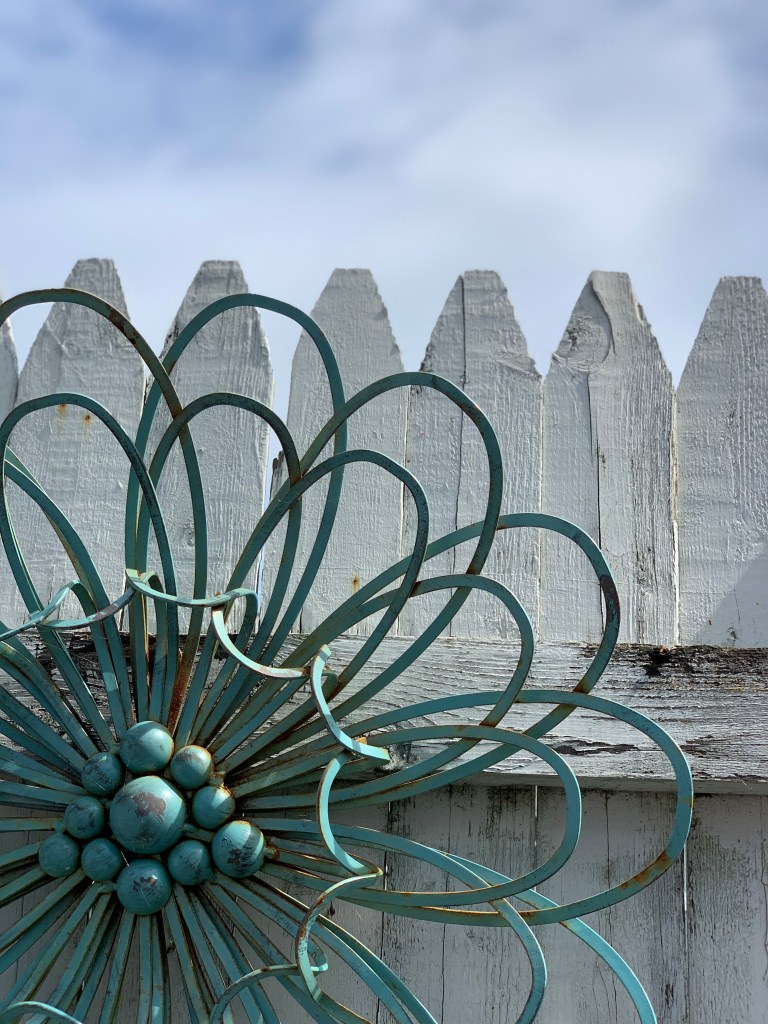
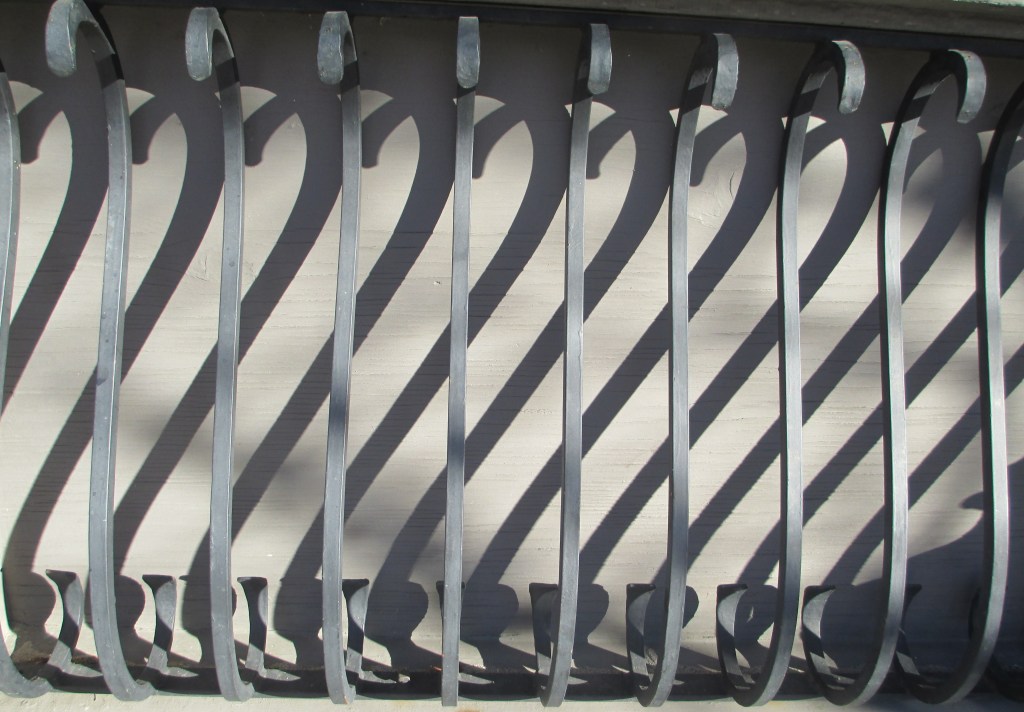
“En guard” is spoken to alert fencers to take their defensive positions, but fences themselves need not be uninviting. They lend scale to and break up the vastness of landscapes. They mark paths and house buoys and tchotchkes and seasonal displays. They are backdrops for posters and banners, and display political sentiments and commercial enticements.

While birds frequently situate themselves comfortably on fences, a fence-sitting human tends to be one unwilling to commit to one side of an issue or another.

For the attentive, an unusual fence can identify the particular place in the world of an otherwise undifferentiated seascape or skyscape.

They may be whole or broken, winding or at strict high alert. Antique or modern. Functional or decorative. Enduring or flimsy, or somewhere in between. Sometimes they completely block one’s view. Others are so porous as to be nearly invisible, wrought of wire that melts into its surroundings. Lush summer flowers may exuberantly burst through their grids.

Sometimes, fences are so perfectly situated within their surroundings that they seem to echo the sky.

At least for awhile.

Simple Gifts

“‘Tis the gift to be simple, ‘Tis the gift to be free, ”Tis the gift to come down where we ought to be…”

When we are lucky enough to choose and be able to navigate our paths, we will always find simple gifts there. A single starling or bud. A cove of cairns. Storm-fallen leaves gathering themselves into a tree formation. A cluster of burnished yellow leaves shaped like a lone heron in a field of pure green.

Glowing lilac petals on two continents and a tiny balletic figure trying to dance out and away from a July flower’s sodden plum-yellow skirt. Reflections rendered in brass ribbons by a dropping sun. Sunny buds singing from limestone seams.

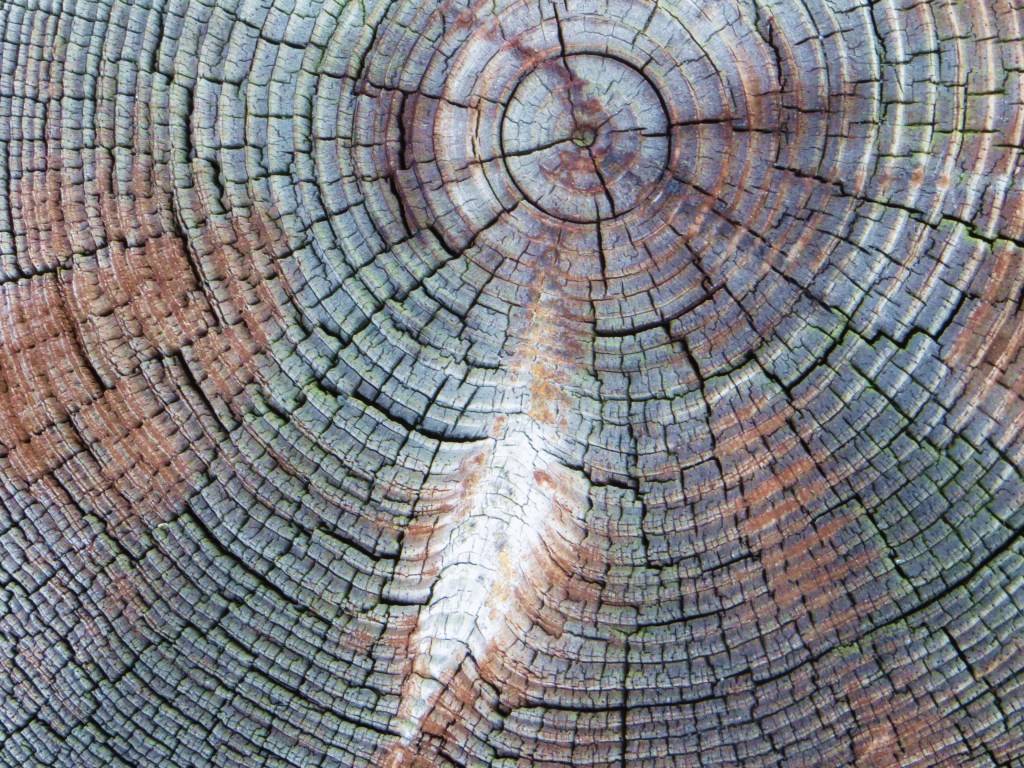
Weathered wood. A slumbering canvas sail about to be unfurled to catch the wind. Each of the infinite time-rounded stones beneath my feet.

Such gifts can be gathered almost everywhere.

Every time I consciously think of the simple gifts around us, I hear a single verse in Alison Kraus’s voice, accompanied by Yo-Yo Ma. And an undertone of Raffi, from a time when my children were young and safe with my husband and me during some of the best days of our lives. Woven into those glorious days, for me alone now, is the lacerating beauty of the music Yo-Yo Ma played at my son’s graduation, two months to the day after his father’s death. The first of so many graduations, including one only weeks ago, which my husband ought to have been able to attend in the more traditional way.

Such Tralfamadorian layering is not only part of each simple earthly gift, but is its essence.

In his introduction to the time traversed and gifts lost and regained in TransAtlantic, the late, great Colum McCann quoted Eduardo Galeano’s exquiste observation about the give-and-take among and melding of memories and moments and movements: “the time that was continues to tick inside the time that is.”

And so it does.

Life Among Roman Ruins (Volubilis)

McCann’s novel has ties to New England, particularly the state of Maine. Perhaps it is not a coincidence that Simple Gifts originated there, too, in a mid-coastal Shaker community where it was thought to have been written by Elder Joseph Brackett of Alfred, who was called to the ministry in 1848.

Almost a century later, Aaron Copland used it in scoring a 1944 ballet, Appalachian Spring, and in 1950 he repurposed it among his Old American Songs. From there, it was a hop, skip, and a few generational jumps to the embedded memories of the parents and children who raptly listened again and again to the old-school Raffi cassette tapes and CDs which carried us into the next century.

When true simplicity is gained,
To bow and to bend we shan’t be ashamed,
To turn, turn will be our delight,
Till by turning, turning we come ’round right
.”

McCann wrote a lesser-known TransAtlantic in the same year he published his historical fiction: the lyrics to the eponymous song in Clannad’s album Nádúr. In it the singer describes walking among the ordinary sights along the roads of her home country, in whose “shadows, a light of” someone absent “flared.” Across the Atlantic again, she walks along the water where “dreams were calling out/ Of sky and stone.”

Simple elements and offerings in complicated and transformative layers and combinations.

From Cóbh to New York, blood and shadows and dreams and memory, water and stone and sky, regrouping and reshaping themselves and us for as long as we are here.

And perhaps long afterwards.

An Eye from the Past to the Present (Delhi)

Spirited Away

Delhi, India

Spiritual sites abound in the great wide world. But we need not go far. Sometimes they are within our homes, or mere steps away. Occasionally they are only in our minds. They may be felt in the presence of the quotidian. A napping cow in Varanasi. A pair of pigeons in Casablanca. Painted panels in a college chapel in Maine.

Varanasi, India

Such sites and sights, for me, are portals to the past. A single gold flower in the wet heat of sunrise over the Ganges in an ancient city. Storks nesting atop ancient Berber-Roman columns’ capstones, open to the heavens after the structures they held have crumbled away. In Volubilis, a nesting parent appeared to bask in the perfection of her landing atop a now freestanding pillar near Meknes.

Volubilis, Morocco

Although I have been known to suspect saints are underfoot, I tend to find more traditional spirits while looking up.

Sometimes, neck-craningly high….

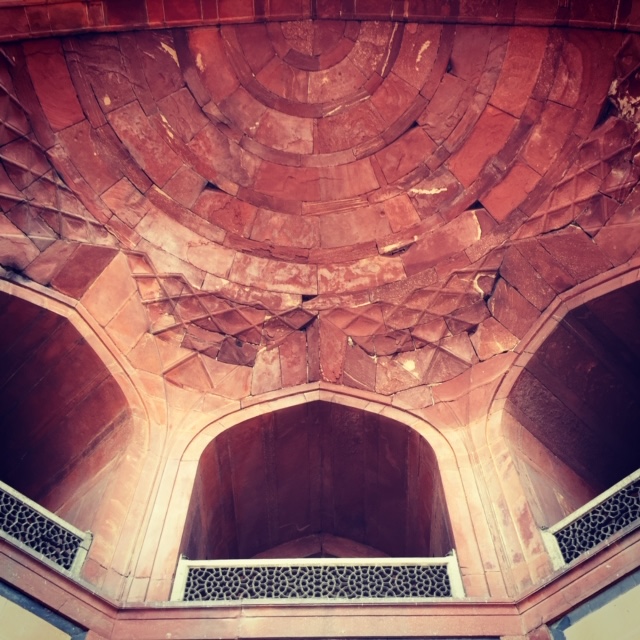
Delhi, India

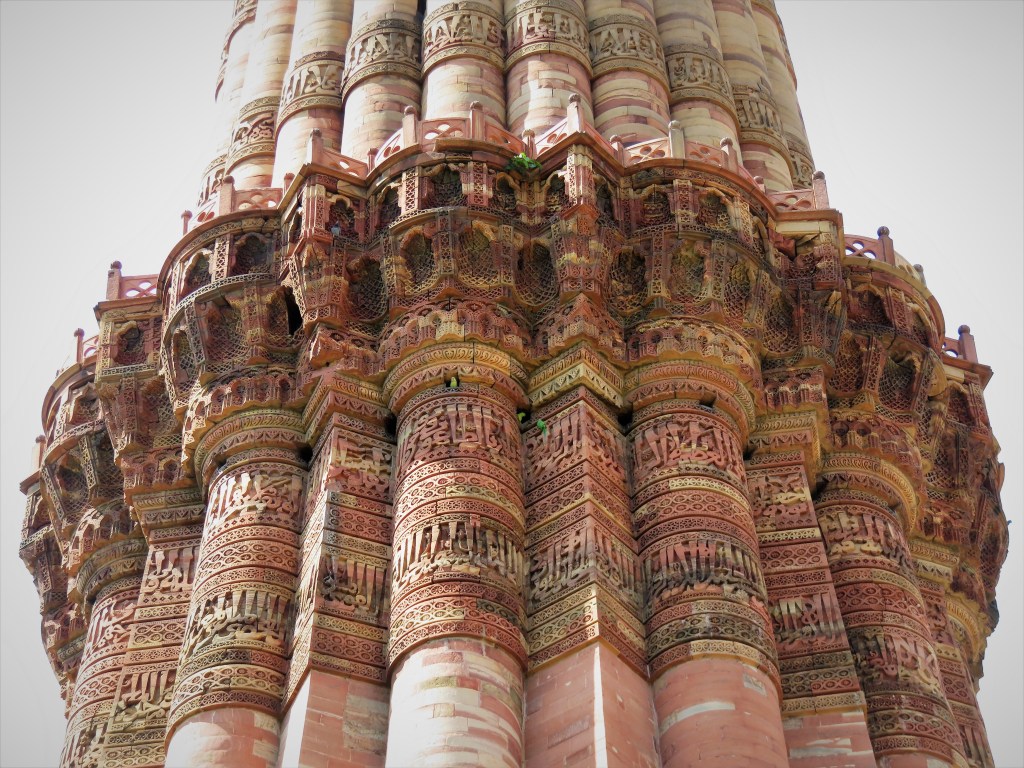
My daughter took me to Qutb Minar, where brilliant lime parakeets looked down on us from a crown of carved bricks on a minaret taller than ten stacked Green Monsters. The view from the ground left me thunderstruck. I can only imagine the awe in surveying the earthbound from such heights.

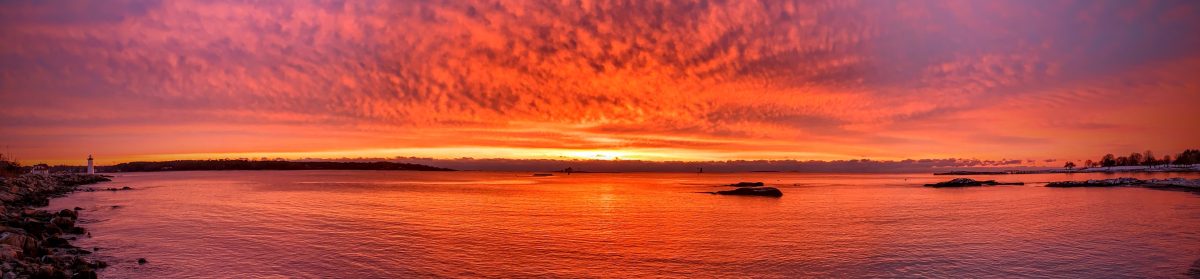
Lowering my gaze to the horizon, I also regularly find spiritual sights and sensations. On gray and pastel mornings, and when an ordinary day catches fire–sometimes just for a few minutes–and on every day in between.

Plum Island, Massachusetts