Looking Over

The more rarefied the vantage point, the rarer (and hence ordinarily overlooked) is the view.

I once followed waterfalls, hiking through woods to a mountaintop garden in New Hampshire’s Ossippee Mountain Range. The mountains were rendered in green at street level, but bathed in bright blue from on high.

This rose stretched exuberantly at the Castle in the Clouds that Father’s Day. Like an outgoing youngest child in a large family, it launched itself above its brethren and refused to be overlooked.

It was not so very far from Mt. Washington, which my husband and I had tried to climb on our 15th wedding anniversary. Ultimately we had to give up on seeing the sights from the highest vantage point in New Hamspshire available to mere mortals. I had insufficient ballast, and was no match for fierce winds across a broad open expanse of rock. It was too difficult to hold onto my steady spouse, and I was nearly swept off the mountain’s face.

(The nearby Mt. Washington Hotel is sometimes mistaken for a very different overlook: The Shining‘s Overlook Hotel; I can assure you the White Mountains’ version is far more serene).

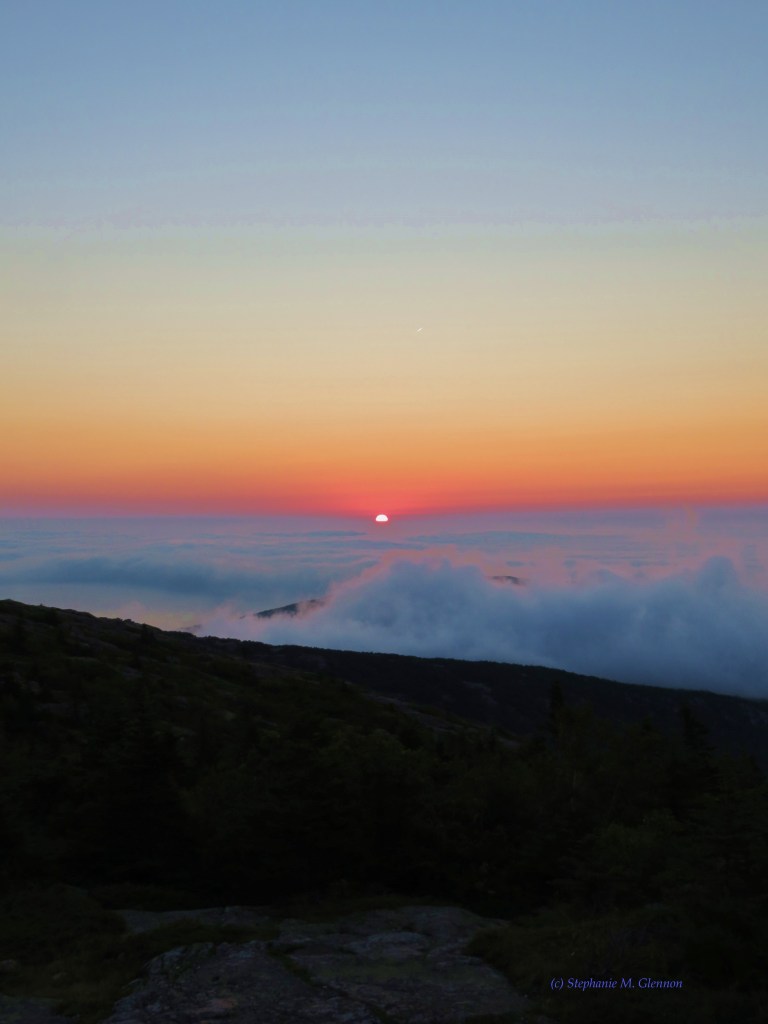
Sometimes I have found myself in thinner air, overlooking a golden world as the sun sets. Or walking through seas of swirling pastel clouds atop Acadia’s Cadillac Mountain, taking in the Northeast’s crown view of a rising sun.
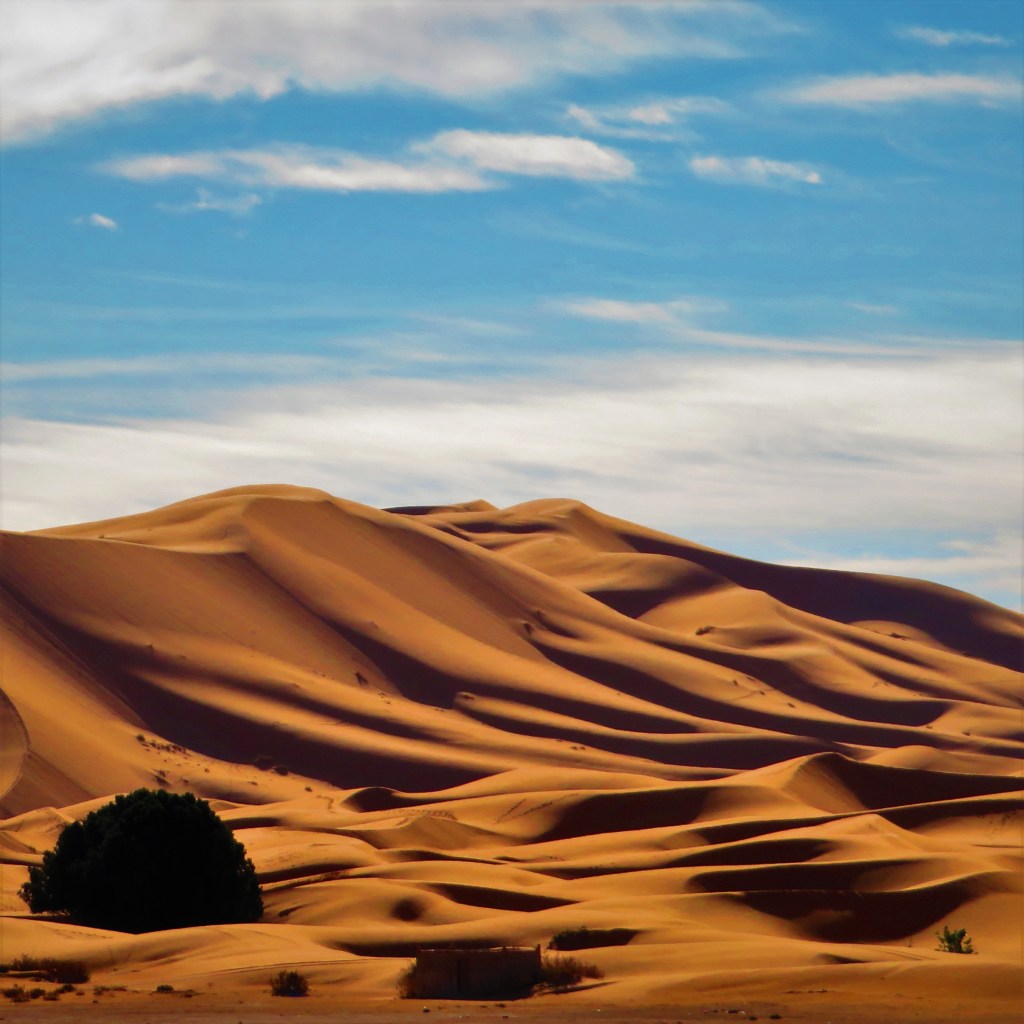
In more recent years, I’ve looked over land and sea and sandscapes from atop camels and towering dunes. From watchtowers and volcanic islands. I’ve surveyed ancient blue and pink cities and violet seas from slitted holes in stone castles and fortresses.
From a distance of many years, I realize I’ve found myself climbing ever-farther upwards on such days.

At dizzying heights, I feel closer to my missing piece. He frequently took photos from such spots when he was here with us, on “earth, our heaven, for a while.” Words I read from Mary Oliver’s “A Pretty Songat his service.

In some ways, we can best see what we’re missing from on high. Where the heady view is also heavenly.

A man looking out over the City of Lights with his daughters, not knowing it would be the last time. The same man on a Equatorial island cliff, knowing it was for the last time, and seeing the rarest of Pacific nesting birds.

One of my children recently told me of Sgùrr Dearg, where we earthbound folks may survey both very present Puffins and great swaths of the visible world from the Inaccessible Pinnacle.

If she climbs it someday, I hope she’ll send me a picture of what she overlooks.

Simple Gifts

“‘Tis the gift to be simple, ‘Tis the gift to be free, ”Tis the gift to come down where we ought to be…”

When we are lucky enough to choose and be able to navigate our paths, we will always find simple gifts there. A single starling or bud. A cove of cairns. Storm-fallen leaves gathering themselves into a tree formation. A cluster of burnished yellow leaves shaped like a lone heron in a field of pure green.

Glowing lilac petals on two continents and a tiny balletic figure trying to dance out and away from a July flower’s sodden plum-yellow skirt. Reflections rendered in brass ribbons by a dropping sun. Sunny buds singing from limestone seams.

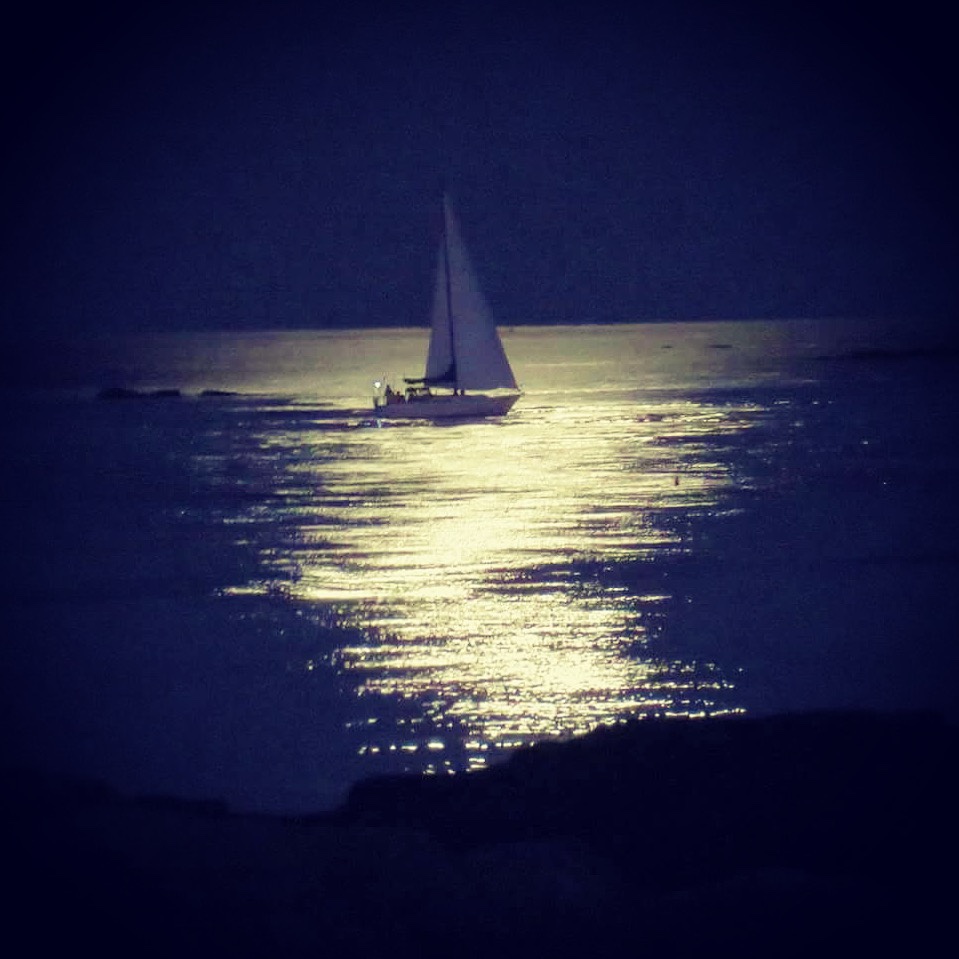
Weathered wood. A slumbering canvas sail about to be unfurled to catch the wind. Each of the infinite time-rounded stones beneath my feet.

Such gifts can be gathered almost everywhere.

Every time I consciously think of the simple gifts around us, I hear a single verse in Alison Kraus’s voice, accompanied by Yo-Yo Ma. And an undertone of Raffi, from a time when my children were young and safe with my husband and me during some of the best days of our lives. Woven into those glorious days, for me alone now, is the lacerating beauty of the music Yo-Yo Ma played at my son’s graduation, two months to the day after his father’s death. The first of so many graduations, including one only weeks ago, which my husband ought to have been able to attend in the more traditional way.

Such Tralfamadorian layering is not only part of each simple earthly gift, but is its essence.

In his introduction to the time traversed and gifts lost and regained in TransAtlantic, the late, great Colum McCann quoted Eduardo Galeano’s exquiste observation about the give-and-take among and melding of memories and moments and movements: “the time that was continues to tick inside the time that is.”

And so it does.

Life Among Roman Ruins (Volubilis)

McCann’s novel has ties to New England, particularly the state of Maine. Perhaps it is not a coincidence that Simple Gifts originated there, too, in a mid-coastal Shaker community where it was thought to have been written by Elder Joseph Brackett of Alfred, who was called to the ministry in 1848.

Almost a century later, Aaron Copland used it in scoring a 1944 ballet, Appalachian Spring, and in 1950 he repurposed it among his Old American Songs. From there, it was a hop, skip, and a few generational jumps to the embedded memories of the parents and children who raptly listened again and again to the old-school Raffi cassette tapes and CDs which carried us into the next century.

When true simplicity is gained,
To bow and to bend we shan’t be ashamed,
To turn, turn will be our delight,
Till by turning, turning we come ’round right
.”

McCann wrote a lesser-known TransAtlantic in the same year he published his historical fiction: the lyrics to the eponymous song in Clannad’s album Nádúr. In it the singer describes walking among the ordinary sights along the roads of her home country, in whose “shadows, a light of” someone absent “flared.” Across the Atlantic again, she walks along the water where “dreams were calling out/ Of sky and stone.”

Simple elements and offerings in complicated and transformative layers and combinations.

From Cóbh to New York, blood and shadows and dreams and memory, water and stone and sky, regrouping and reshaping themselves and us for as long as we are here.

And perhaps long afterwards.

An Eye from the Past to the Present (Delhi)