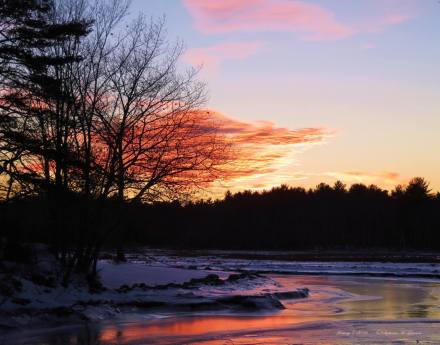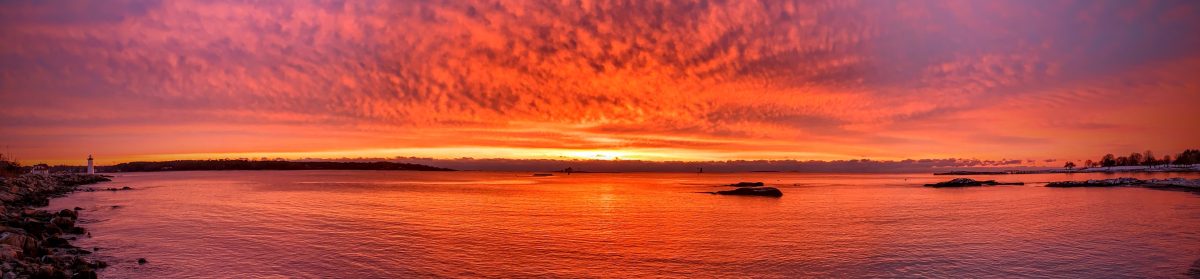
An hour before sunrise, waves rushed and leapt and sprayed, leaving a molten crimson cast on the rocky shore. This is the the same spot where my children planted a beach bouquet .
The sun ignited a more tentative, delicate ballet. It seemed to whisper from both wings, limbs of light clasping each other at the horizon as dawn’s bright white clouds began to swirl and glide overhead.
As birds began singing in earnest, one sturdy late winter branch bowed to its more petite neighbor, whose arms were outstretched, as if extending an invitation to tango.
Five years ago today my children and I brought their father home to die.
Before we married, Jim promised me we would have five boys.
Because I was very young, somewhat gullible, and only took college laboratory courses because I had to (notwithstanding my lack of scientific skills), I believed him.
We had two boys in under two years. Promising start.
On a windswept January day the following year we had a few extra hours on our hands: my scheduled delivery had been moved to make way for an emergency one. (I did not prove much more successful in the childbirth department than I had in the hard sciences.)
We took our toddlers to breakfast at a riverside restaurant where I managed–just barely–to slide my mid-section behind a sturdy stationary pine table where the boys laughed and gave us sticky kisses before we dropped them off to play with friends–and Winston, the venerable bulldog.
Jim had only sisters and I had only brothers, and despite having some experience growing up as a girl I never felt equipped when among girl friends to understand how that is, or should be, done. I assumed that we would have a third son by mid-day; he let on to me that he thought we’d be bringing home a Holly or Fiona.
We stopped at a nearly empty restaurant near the hospital and Jim had something to eat; I was not allowed to partake before surgery.
The owner looked at me and smiled, “When are you due?”
I glanced at Jim’s watch. “He should be here at 12:42,” I said.
She gave me a hug.
Then the two (almost three) of us went to the seashore, and walked hand-in-hand down a snow crystal-glazed path to the ocean. A few hours later, beautiful Emma arrived, not with a howl but with a thoughtful, piercing and curious gaze from the second her enormous eyes adjusted to what we then knew as light.
The Wings of an Angel, the Wings of a Dove
Emma was a teenager when her father died. She is in such important ways like him, the man who taught her to love finches.
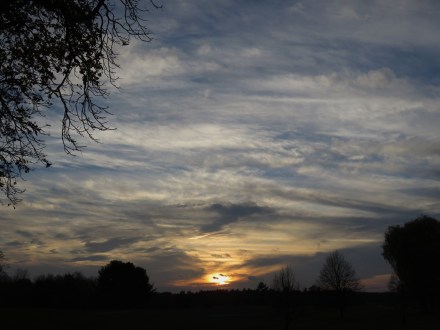
As sunset gathered on her birthday this winter I felt compelled to turn my steering wheel off course and drive back to that seashore spot, where layered gold and orange clouds settled in one spot to form unmistakable wings so bright they lingered as an after-image even when the sky turned gray and only the smudged plum outline of a single bird soared over the sea.
A year ago our friend Chris passed away at home, where his loving family cared for him. Grieving people are often told that the “first year is the worst,” and, less frequently, advised that people tend to be very solicitous of the grieving during that first year. The first year is awful, but is leavened by others’ support and presence. It is a great help when the support continues just as the grief does; the passage of one year is a milestone, but it does not end the pain or yearning.
If you know people who are grieving–and who does not?–please let them know that you continue to think of the person they loved, forever after that first year has passed.
Dawn. It was our friend’s last day, a Sunday, fittingly for a man of such faith.
*****
Almost five years ago, a week after my husband Jim was diagnosed with pancreatic cancer, Chris strode into our lives. We were then only just getting to know his oldest child, who has since become like a son to me.
It’s an understatement to say it was a delicate time in our lives, given the shock and awe of that diagnosis.
Chris and his son arrived in our gravel driveway in a Crown Vic that now sports a Marine sticker. No one cuts off the driver of such a car. Jim and I went to the front door when we heard the gravel crunch and the car doors thunk shut.
Chris powered over the old pine boards to the pine green door where many others who’d known us for years hesitated and others…
Fledge, as a transitive verb, means: “(1) To rear until ready for flight or independent activity; (2) To furnish with feathers.”
Tiny birds burst out of bushes at fender level, lifting by milliseconds out of oncoming cars’ paths. Parental sentries warily scan their nests’ peripheries, screeching and swooping if a squirrel bounds too close to their young ones.
Baby Quail (c) 2015
Where hatchlings cluster in the delicate days before fully testing their wings one can already see a hierarchy in place, more assertive newborns pecking at their recalcitrant siblings and even sweeping them aside as they venture toward the margins of the zone where their parents perch to guard them.
Perching Guard (c) 2015
I am, technically speaking, a grownup. I assuredly am my children’s only surviving parent, and some of them occupy the chronological ground between childhood and adulthood. Yet I am taking most of the lessons. That fledgling bluejay perched indefinitely on the wooden fence ledge, glancing beseechingly back over his shoulder as if to ask whether he really is expected to let go and explore alone beyond the garden that is his home base? Really? Is this a good idea? That’s me.
While I have found comfort in returning to my original work, my children have ventured without fear into new places, figuratively and literally–from making new friendships to mapping out intricate proofs and gathering data across the globe to mathematically model the spread of infectious diseases. How proud their father would be.
Perhaps they have been furnished with that other thing with feathers– the one “[t[hat perches in the soul,” that “sings the tune without the words,/And never stops at all.”