Each closing time is of course also some other beginning’s end. More of another slide around a circle. We rarely know the exact moment anyone we love will no longer be traveling hand-in-hand with us (at least in a way others can see) or how thin the space between us may remain.
Sometimes we know that day will come all too soon.
Measured in traditional human time, this is a fairly momentous anniversary of one of those days of physical parting. The final days of my husband’s life, in our home, have haunted me so much that since then I’ve found myself fruitlessly packing up and fleeing, more than once, with assorted combinations of children and beagles and oh-so-much weight in ultimately ephemeral belongings. The things we carry.
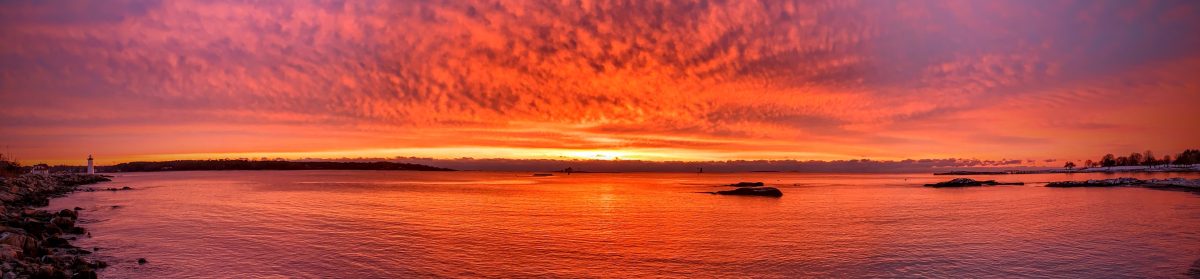
I think that today, he’d want me to share some of the heavens I’ve seen in solitude over the years only because I heeded his wish to get outside. To breathe in the wee hours when I’d need to make room to see the big picture, where it’s never closing time.
The more rarefied the vantage point, the rarer (and hence ordinarily overlooked) is the view.
I once followed waterfalls, hiking through woods to a mountaintop garden in New Hampshire’s Ossippee Mountain Range. The mountains were rendered in green at street level, but bathed in bright blue from on high.
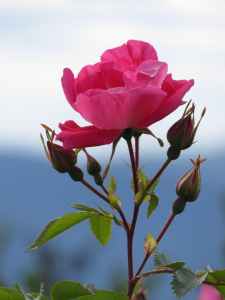
This rose stretched exuberantly at the Castle in the Clouds that Father’s Day. Like an outgoing youngest child in a large family, it launched itself above its brethren and refused to be overlooked.
It was not so very far from Mt. Washington, which my husband and I had tried to climb on our 15th wedding anniversary. Ultimately we had to give up on seeing the sights from the highest vantage point in New Hamspshire available to mere mortals. I had insufficient ballast, and was no match for fierce winds across a broad open expanse of rock. It was too difficult to hold onto my steady spouse, and I was nearly swept off the mountain’s face.
(The nearby Mt. Washington Hotel is sometimes mistaken for a very different overlook: The Shining‘s Overlook Hotel; I can assure you the White Mountains’ version is far more serene).
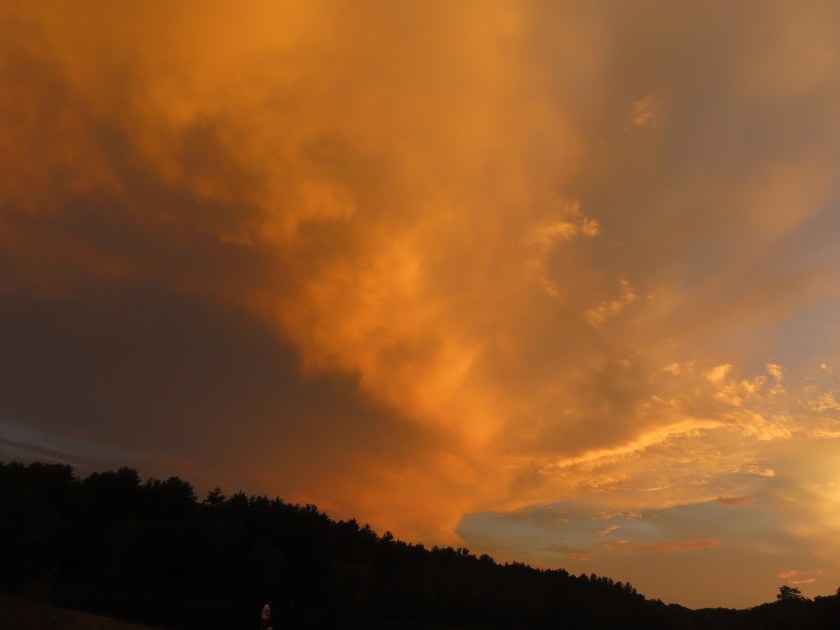
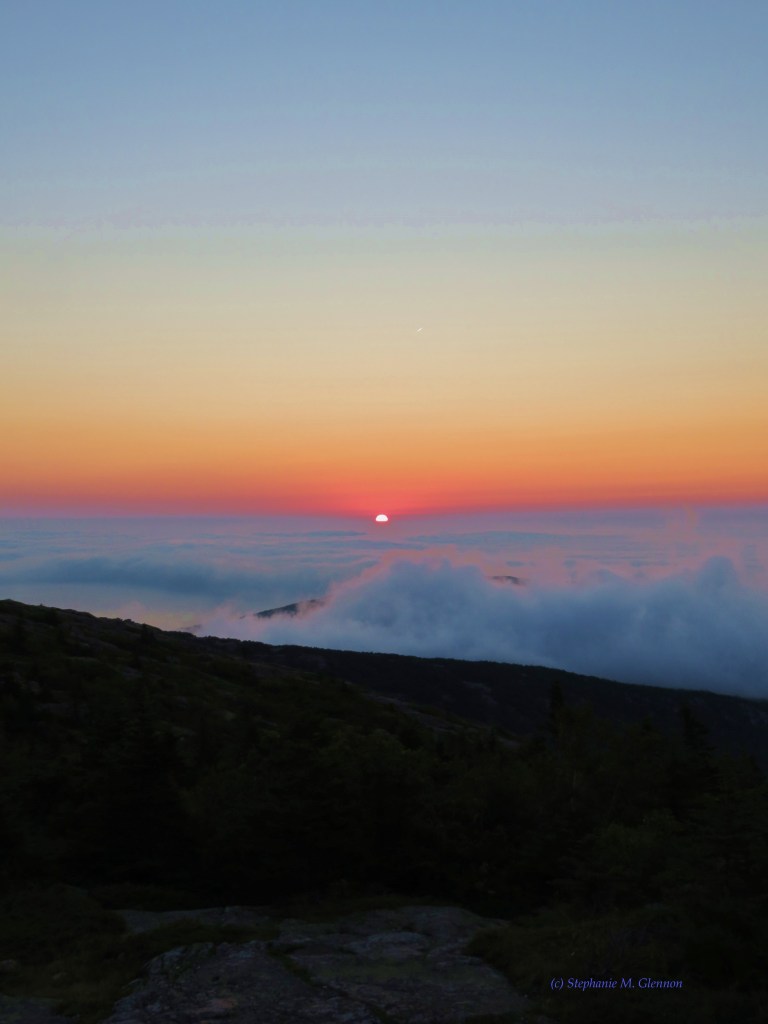
Sometimes I have found myself in thinner air, overlooking a golden world as the sun sets. Or walking through seas of swirling pastel clouds atop Acadia’s Cadillac Mountain, taking in the Northeast’s crown view of a rising sun.
In more recent years, I’ve looked over land and sea and sandscapes from atop camels and towering dunes. From watchtowers and volcanic islands. I’ve surveyed ancient blue and pink cities and violet seas from slitted holes in stone castles and fortresses.
From a distance of many years, I realize I’ve found myself climbing ever-farther upwards on such days.
At dizzying heights, I feel closer to my missing piece. He frequently took photos from such spots when he was here with us, on “earth, our heaven, for a while.” Words I read from Mary Oliver’s “A Pretty Song” at his service.
In some ways, we can best see what we’re missing from on high. Where the heady view is also heavenly.
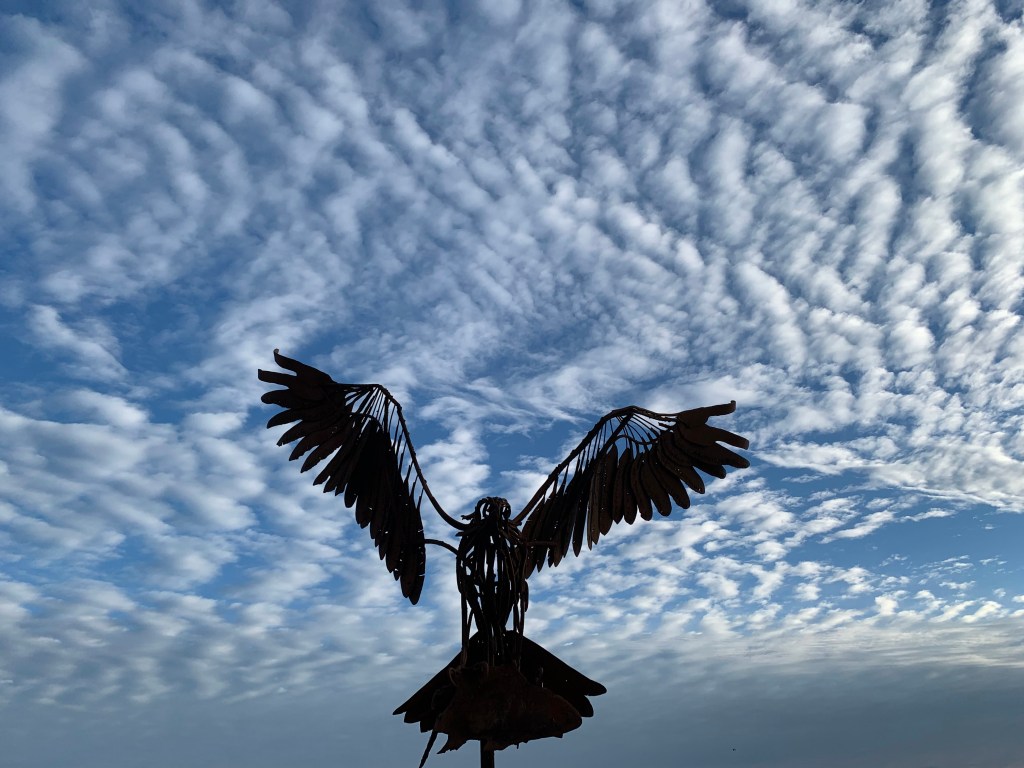
A man looking out over the City of Lights with his daughters, not knowing it would be the last time. The same man on a Equatorial island cliff, knowing it was for the last time, and seeing the rarest of Pacific nesting birds.
One of my children recently told me of Sgùrr Dearg, where we earthbound folks may survey both very present Puffins and great swaths of the visible world from the Inaccessible Pinnacle.
If she climbs it someday, I hope she’ll send me a picture of what she overlooks.
Overhead at the spot where we married, Memorial Church, Cambridge, Massachusetts
” . . . [T]here are three people in a marriage, there’s the woman, there’s the man, and there’s what I call the third person, the most important, the person who is composed of the man and woman together.”
–Jose Saramago, “All the Names”
” Because, you know, you and your spouse are, like, one.”
–Melissa Gorga, “Real Housewives of New Jersey”
I’d like to weigh in as a mom. One with young daughters and sons. The remaining member of a couple who lived out our wedding vows until–and in a way after–death us did part.
I believe in osmosis–the continuing two-way exchanges within a good marriage. It’s not so much that one consciously molds or shapes a partner, but I think sustaining loving relationships let us incorporate the best parts of one another.
The person the two of you become can be a better human being than the people you once were.
(I refuse to link to an original mom “manifesto,” issued by, I am somewhat pained to say, a fellow alum who produced two sons. She wrote an open letter–published in the school newspaper of the university her son then attended–exhorting the nubile female undergraduate population promptly to set about seizing husband material from the upper classes. In a subsequent self promotional tour, she paused theatrically and announced, without benefit of a preceding question, “Yes, I went there.” To which John Stewart responded, “Where? The 1950s?”).
Wedding Flowers
I’ll spare you reading that screed and report that–while celebrating the supposed uber-marriagability of her sons and their male classmates–her clarion call to to other mothers’ daughters did not contain a single discussion of love, kindness, faith, grace, friendship, or anything like a commitment of souls for better and worse.
Your College Romantic Relationships, or Lack Thereof, Will Not Doom You.
Three Cheers . . .
First a disclaimer: I happen to have married a man I met when I was a teenage college student. It was a statistical improbability that this relationship would last.
He broke up with me after nearly a year.
I didn’t take it all that well.
What he said, with some puzzlement at my surprise: “Did you think it would last forever?”
What he didn’t say, but what I read in his decision and discomfort: “You’re my first girlfriend. We’re still teenagers. Neither of us has any experience with a serious relationship. How could this possibly survive?”
As it happened, he reconsidered. And it did last forever.
Jim’s Closing Ceremonies took place in a church on a school campus, attended by multitudinous children and teenagers. The Reverend commented on the beginning of our marriage.
“And don’t rush it, guys,” he told them. “But if you chance to meet someone at seventeen and think, ‘This is my life partner,’ know that sometimes it works.”
The key word here is chance. Happenstance. Serendipity caused us to meet. A confluence of love and hope and compatibility, as well as innumerable concrete events we did not control, led us to marry.
Had any number of other choices been made in either of our lives, no doubt we would have had other relationships and become very different people. But I guarantee that the quality of the marriage wasn’t influenced by us attending the same college.
If my own children one day emerge in their adult lives with partners they had in college, then great. And if not, great. I will never subscribe to, let alone ply, the misguided notion that a “name” school is necessarily the ideal breeding ground for . . . well, finding someone with whom to breed.
I do believe that everywhere my children have gone and will go–from the playgrounds where they ephemerally encountered fellow littles (hat tip to E. Lockhart) to the coffee shops they may frequent; from the bands, dance troupes, trivia nights and game boards where they gather to the far-flung countries where they are immersed in different languages and cultures–is a way to learn how to love and value other people.
If romantic love comes to town along with that, fine. And if not–as any widow or widower can tell you–that’s not all there is.


















 Love in the Spaces