It will never cease to amaze me that this picture of my beaming husband, with his ever-present off-duty camera, was taken just ten weeks before he died. And that his (physician’s) heart knew it. His smile remained true while mine, at very best, merely quivered on the edge of despair.
I can only now see that I was literally incapable of facing straight ahead as he did.
That year, Father’s Day fell ten weeks after his death. For the first years I couldn’t even face special occasion greeting card displays in the drugstores which commanded my frequent trips as various injuries and ailments visited our household.
The next Father’s Day began in Belfast. In the day’s drenching early morning hours, I came close to creating an international incident while bringing his ashes to Northern Ireland. Four years later, on Father’s Day, my own father died. Ten Junes later, we gathered for his father‘s burial.
As I said, it’s a complicated Sunday.
Father’s Day overlooking New Hampshire’s White Mountains, from the Castle in the Clouds
As our children have gone off to school and dispersed, I’ve often spent the day alone, always outside, as he would have liked to be. We’ll do that today, too, whether the sky stays clear or not.
I’ll continue mourning the absence of his guidance and wisdom and kindness, most of all for our children but also for the endless friends and patients and strangers his presence on the planet would have continued to make better in the decades he should have had with us.
I’ll ache for the absence of the look he’d have had as he photographed a full solar eclipse and a blazing aurora he could have seen just outside our old yellow house in New England.
I’ll feel sorry for myself, for the absence of the unpierced heart and unvanquished hope I once had.
And I’ll be thankful because I still hear and see and feel him in every full and empty and in-between space.
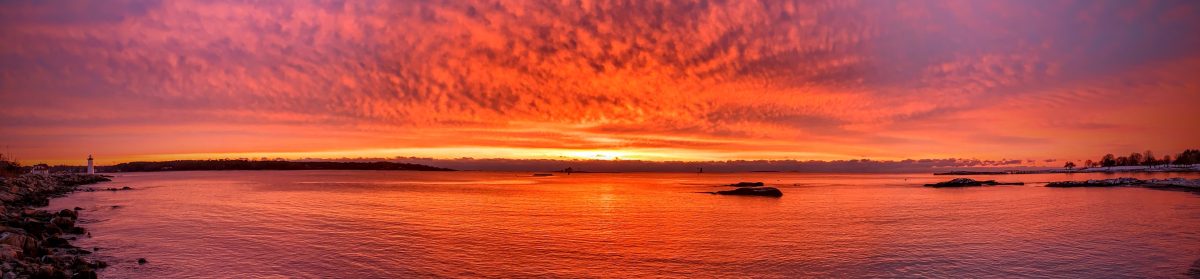
At 4:30 a.m. the waterfront view is fully saturated one day and colorless mist the next. The best hints I gather from my starting vantage point a few blocks away lie in the light: usually a patch of shimmering silvery-slate in the deep blue-black signals an unsubdued sunrise, and I quicken my pace.
It’s a little bit like Forrest Gump’s box of chocolates, or the first view of monochromatic tartan turf from inside Fenway Park: you might gather clues or intuit what your senses will tell you before you get to it, but until you do it’s never a sure thing.
I took this shot before the morning light last week before travelling several hundred miles for my younger daughter’s college graduation.
My little girl. I dropped her off at college and when it was time to say goodbye watched her twirl around and dance away in a swirling aubergine skirt, knowing she was “alright as she left” her home port.
Ten hours later, driving back to a truly unoccupied house that had seemed empty when it was inhabited by a family of only five, I was lost in an industrial park in Connecticut and found the CD my husband had somehow arranged for me to find two-and-a-half years after he died, popping it in to play and knowing only that he had selected for me John Hiatt songs from an enormous ouvre.
Before leaving home I asked my youngest if I should bring anything–did she want me to bring the necklace her father gave her for her birthday, just three weeks before he died? On a delicate silver chain is a ruby–her primary school color, and a shade not unlike her long, curly hair–surrounded by small diamonds, a treasure she let me keep in a safe place despite knowing of my tendency to forget where I have secreted such things.
She did, and I brought it for her to wear.
When we arrived, my now young adult youngest child met us at the airport, smoothly executing a parallel parking maneuver I still can’t pull off. She whisked us to her apartment and commencement eve’s blizzard of friends and activity.
A university her father did not know she would attend. A boyfriend of four years whom he never met. A city he had never visited. Friends whom he would have been so delighted to see supporting her.
After deftly reparking the car I had left egregiously unmoored from the curb, my graduate-to-be walked ahead of me in a flowing, bright printed dress, part of a wardrobe I’d never seen. I recognized the shoes, heels with an intricate cut-out design which we’d bought for her first birthday without her dad. We’d traveled together to Vermont, where the six of us had often spent her winter birthday, and I’d trudged aimlessly in an uncharacteristically muddy early March, hearing a little girl happily calling out “daddy” from a bunny slope.
While we were together I saw my daughters exchange glances quite a few times, at more than one restaurant, before gently reminding me that I kept asking for tables for one more person than was to be dining with us.
Only one of us does not have a major transition going on–new homes and jobs and graduate schools, and all their attendant and considerable hopes and stresses.
We can’t know exactly how all of these changes will work out, and while it may not be wise to steer too hard a-starboard, keep walking ahead of me. Someday I may catch up.
Overhead at the spot where we married, Memorial Church, Cambridge, Massachusetts
” . . . [T]here are three people in a marriage, there’s the woman, there’s the man, and there’s what I call the third person, the most important, the person who is composed of the man and woman together.”
–Jose Saramago, “All the Names”
” Because, you know, you and your spouse are, like, one.”
–Melissa Gorga, “Real Housewives of New Jersey”
I’d like to weigh in as a mom. One with young daughters and sons. The remaining member of a couple who lived out our wedding vows until–and in a way after–death us did part.
I believe in osmosis–the continuing two-way exchanges within a good marriage. It’s not so much that one consciously molds or shapes a partner, but I think sustaining loving relationships let us incorporate the best parts of one another.
The person the two of you become can be a better human being than the people you once were.
(I refuse to link to an original mom “manifesto,” issued by, I am somewhat pained to say, a fellow alum who produced two sons. She wrote an open letter–published in the school newspaper of the university her son then attended–exhorting the nubile female undergraduate population promptly to set about seizing husband material from the upper classes. In a subsequent self promotional tour, she paused theatrically and announced, without benefit of a preceding question, “Yes, I went there.” To which John Stewart responded, “Where? The 1950s?”).
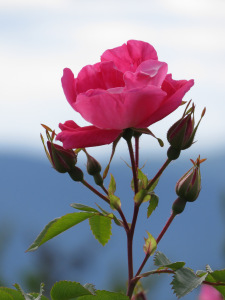
Wedding Flowers
I’ll spare you reading that screed and report that–while celebrating the supposed uber-marriagability of her sons and their male classmates–her clarion call to to other mothers’ daughters did not contain a single discussion of love, kindness, faith, grace, friendship, or anything like a commitment of souls for better and worse.
Your College Romantic Relationships, or Lack Thereof, Will Not Doom You.
Three Cheers . . .
First a disclaimer: I happen to have married a man I met when I was a teenage college student. It was a statistical improbability that this relationship would last.
He broke up with me after nearly a year.
I didn’t take it all that well.
What he said, with some puzzlement at my surprise: “Did you think it would last forever?”
What he didn’t say, but what I read in his decision and discomfort: “You’re my first girlfriend. We’re still teenagers. Neither of us has any experience with a serious relationship. How could this possibly survive?”
As it happened, he reconsidered. And it did last forever.
Jim’s Closing Ceremonies took place in a church on a school campus, attended by multitudinous children and teenagers. The Reverend commented on the beginning of our marriage.
“And don’t rush it, guys,” he told them. “But if you chance to meet someone at seventeen and think, ‘This is my life partner,’ know that sometimes it works.”
The key word here is chance. Happenstance. Serendipity caused us to meet. A confluence of love and hope and compatibility, as well as innumerable concrete events we did not control, led us to marry.
Had any number of other choices been made in either of our lives, no doubt we would have had other relationships and become very different people. But I guarantee that the quality of the marriage wasn’t influenced by us attending the same college.
If my own children one day emerge in their adult lives with partners they had in college, then great. And if not, great. I will never subscribe to, let alone ply, the misguided notion that a “name” school is necessarily the ideal breeding ground for . . . well, finding someone with whom to breed.
I do believe that everywhere my children have gone and will go–from the playgrounds where they ephemerally encountered fellow littles (hat tip to E. Lockhart) to the coffee shops they may frequent; from the bands, dance troupes, trivia nights and game boards where they gather to the far-flung countries where they are immersed in different languages and cultures–is a way to learn how to love and value other people.
If romantic love comes to town along with that, fine. And if not–as any widow or widower can tell you–that’s not all there is.




 Love in the Spaces