….Voices Carry

I have only recently been freed from silence’s surlier bonds. Paradoxically, it’s left me a bit tongue-tied.

It’s hard to know where to begin, so I’ll start with a sunrise.

One that I doubt I’d otherwise have seen.

My son had taken me to what I’m told is one of the most photographed lighthouses in lighthouse-rich New England. Walking gingerly towards it, steadying myself on the arm of a son who’s grown to be almost his dad’s height, no other humans were in sight.

The light that began weaving through predawn dark was extraordinary. Bright orange began threading itself along the horizon. Magenta and lavender sprouted in patches on indigo sky. Then it turned to the most extraordinary pink display I’ve ever seen, before disappearing into an ordinary blue sky. No one who passed by after those suspended moments would have been any wiser to the magic.

The picture I’m sharing wasn’t of sunrise that year, or that day, or the surrounding ones. That deep blue-green camera had ended up shattered in the wreckage of my car, which I mercifully never saw again. The photographs of the damage were more than disturbing enough for me.

I was hit so ferociously hard and at such high speed that morning that my driver’s side door handle broke off and my car spun more than a full rotation, the driver’s side crushed in at the point of first impact, the rear bumper detaching at a second impact as I spun. I felt something spattering and thought it must be my blood, and wondered who would tell my children and look out for them. I was later told it was a mercy I’d been hit at just the angle at which my driver’s side airbag didn’t deploy, because it likely would have snapped my neck given my (not hefty) size.

Since that day I’ve felt like a shadow.

Fears I’d been so proud of leaving behind returned and magnified. I’ve been in intractable pain from spinal injuries, and a traumatic brain injury has taken away so much more. I’m not the same person. I’m not the mother I’ve needed to be. I lost the ability to do the job I loved nearly as well as victims deserve. I’m not even the writer I was. I’m tentative in a way that doesn’t feel anything like me.

And while overwhelmingly the people in my life have been beyond helpful and supportive and kind, I’ve also been dropped cold by two people I’d been a loyal friend to for years, revealed to be incapable of such bonds. That’s sometimes been a deeper blow than the physical pain.

But even in all this turmoil and pain, I’ve been blessed with the community here. In my rare appearances in the long interim when it was I who was a prospective witness and could not yet speak, I have been amazed and grateful at those of you who keep reading and giving me excuses to share my photos. I’ve even talked to some of you in real life (you know who you are, and thank you so much for checking in on me after I went silent).

I hope I’m back for a good long while.

All photos (c) SMG

Done and Undusted

Every living and growing thing is a work in progress, as are most inanimate and many unseeable things. Tulip bulbs and time-smoothed rocks. Reflections, both visible and internal. A trip by land or sea or sky. Quilts , from the sketching to the sewing process. Sunrise. Anger. Taste in art and novels. Betrayal and trust, both in the building and in the breach.

Landscapes and visitors to them. Altitude and attitude.

Hope and regret and resignation.

Memories. Love.

Lunch.

Even when something’s done and dusted–including long after I’ve pressed “publish”–everything I write remains a work in progress. When I revisit an old post, or a brief I filed decades ago, I often wince at something that could have been better said.

Each post I’ve made in the past many months has required a scandalous number of revisions–not because of a change in the way I write, but because of changes in me. (Although I suspect that is a chicken-and-egg construct for most people who write).

The writer I am in the moment is never the writer I was in the past. Sometimes, for better and worse, I hardly recognize prose as mine. I’m occasionally pleasantly surprised. (More often, I think, “How could I have missed that mistake when I read my draft aloud . . . four times?”)

Every living and growing thing is a work in progress, as are most inanimate and many unseeable things. Tulip bulbs and time-smoothed rocks. Reflections, both visible and internal. A trip by land or sea or sky. Quilts , from the sketching to the sewing process. Sunrise. Anger. Taste in art and novels. Betrayal and trust, both in the building and in the breach.

The quilts I’ve sewn since I was ten are, by their nature, works in often reductive progress. The better loved a baby quilt, the more it tends to emerge from its recipient’s childhood in a very different and diminished physical state (not unlike its seamstress). It begins and ends in pieces.

The process of handmaking a quilt, followed by a child’s enthusiastic use of it, is like a Riddle of the Sphinx writ in 100% cotton prints. The binding at the quilt’s edges–always the final touch when making it–is almost always the first to go. Its tightly woven threads are worn away by tiny hands grasping it for comfort. Entire brightly-colored applique shapes sometimes follow suit, fading and letting go like petals once they have been loved back to exhausted pieces. The hand-stitched threads that secured them can only take so much love and laundering.

This goes for my photographs, too, in a way. I now take photos in somewhat less absurd quantities than I acquire fabric. My early landscape and seascape photos were . . . not good. I tended to emulate my longtime Deering camp friends’ band motto–“Quality through volume.” But along the way, I grew from sheer practice to be able to frame shots. To catch the ephemeral when it was willing to be caught. To wait patiently, no matter what was buzzing and slithering and stinging nearby . To appreciate what was temporarily in my sight, and that a rushed shot would not enhance my chances of preserving something special.

This morning was summer-steamed, shrouded in deep gray mist. But I thought I spotted a visitor to a darkened house just off a very busy main road. From a distance, I quietly zoomed in and took a single photo.

I may still have work to do, but the fawn posed perfectly before loping away.

I couldn’t have improved on it.

Here Today . . .

img_9220

It might seem like an ordinary spot.

Now, as then, one rock’s broad surface comfortably seats a man over six feet tall, allowing him to look up at the much slighter young woman facing him under a Long Nights Moon.

You faced the moon and I faced you. . . .

Technically I have been alone when revisiting the spot, in mind or body.  Even now, few couples would make the rocky climb on a December night. Its most perilous stretches had no guard rails then. Hemmed by poison ivy and washed by surf, scattered signs warned of the trek’s perils, beginning with the precipitous drop from unsteady earth to roiling sea. 

And we talked about the future we hoped to have and came to be

From the narrow, rutted path’s highest point, where the young man sits and she stands, an  overlook offers a panoramic view of the horizon, bracketed by ridged limestone shelves angled into the seabed, as glaciers had decreed.

img_6546 copyThe young man’s vision is razor-sharp, as it will remain all his life. Beyond his moonlit partner he sees a swath of inky, noisy ocean punctuated only by a rocky outcropping miles from shore. There, tiny Boon Island personifies the word “barren.” No less a luminary spirit than poet Celia Thaxter, of New Hampshire’s convivial close-knit Isles of Shoals and their blooming gardens, is said to have once described Boon Island as “the forlornest place that can be imagined.”   

Despite its size and solitude, its uneven granite has drawn in and grounded ships over the centuries. And more than one sturdy stone lighthouse there has been storm-toppled into the sea, rearranging itself into mazes on the ocean floor.

The distant toothpick of the most recently rebuilt lighthouse is in fact New England’s tallest. Standing at strict attention atop the granite pile where nothing grows, it laconically cycles its pure white light, lest another insufficiently attentive traveler come too close. 

Compared to its nearest neighbor, the gaudily scarlet-strobing, holiday-bedazzled and aggressively photographed Nubble Lighthouse, one would have to concentrate very carefully to commit this shy slender cousin to pixels or film. When one does, the tiny island itself often appears to be hovering above the water, as if it is present both as we know it to be and also its own ghost.

img_8061 copy

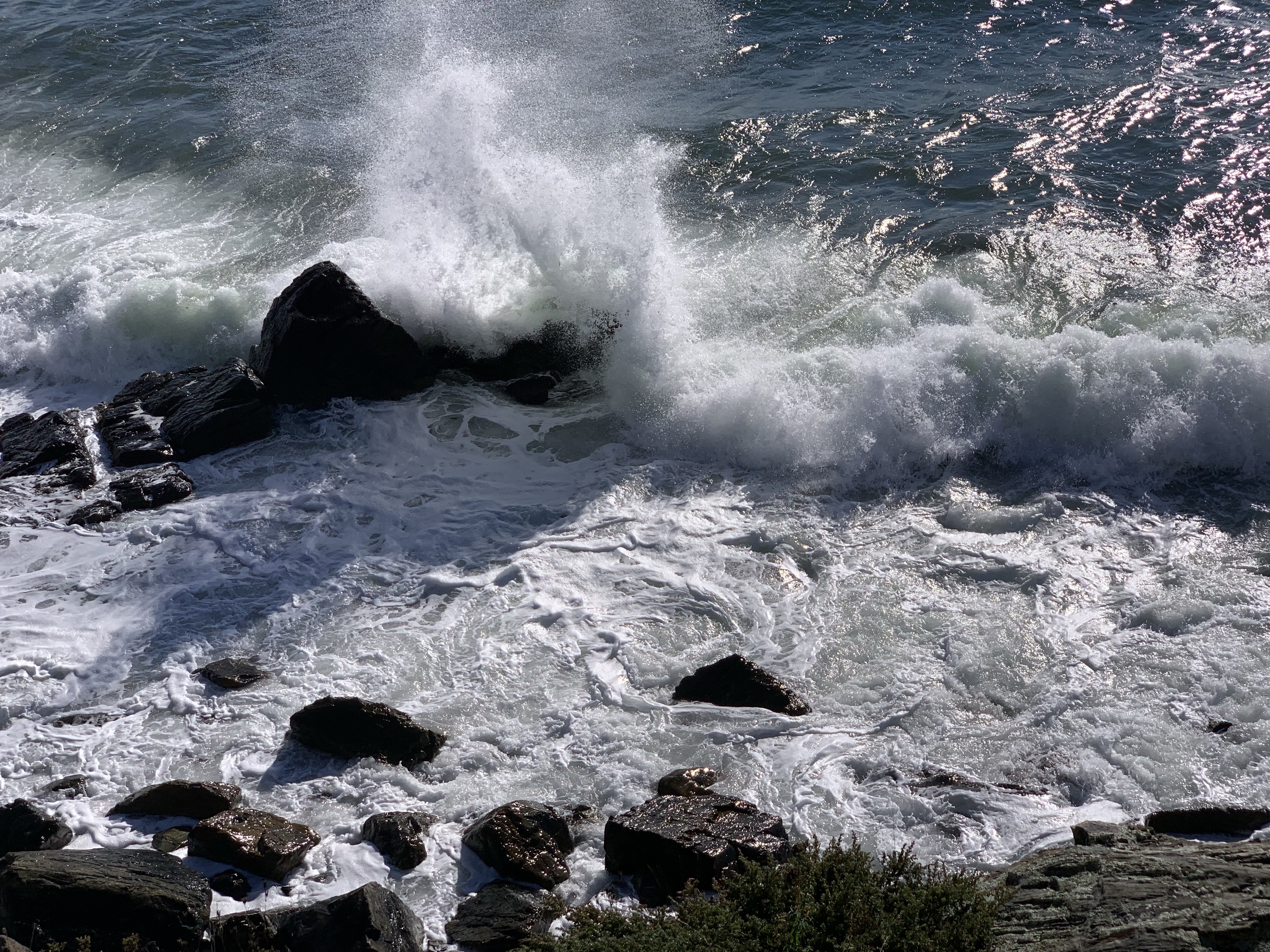
At this spot my husband and I shared at the cliff’s edge, the only sound likely to be heard during any season gently floated upwards. Thousands of water-smoothed stones companionably clattered as waves cycled below. They mingle and chatter as each wave washes over them and recedes, resettling their companions only slightly as they all await the next incoming wave. The sound becomes less mellifluous only in the most ferocious storms–the rare, intense storms we sometimes do not sense are coming, and which might fell even the most dependable beacons.

It is no coincidence that this single quotidian patch of earth and rock snuck itself into  my subconscious memory, and in turn has played a role in both my  fiction and non-fiction.

My husband died almost twelve years ago, but I will always find him–and our younger selves and our future children–in this spot, at least as present as the rocky shore and surrounding sea, and the seagulls who pause to quietly survey the rising sun along with me.