Live-blogging never lost love, from Blue Angels in the backyard to penguins on the Equator
Author: Stephanie
In her spare time, Stephanie has published articles and delivered talks in arcane fields like forensic evidentiary issues, statistical presentations of human and canine DNA testing, jury instructions, and expert scientific witness preparation. She attended law school near the the banks of the Charles River and loves that dirty water; she will always think of Boston as her home.
You are welcome to take a look at her Facebook author page, or follow @SMartinGlennon on Twitter and @schnitzelpond on Instagram. Bonus points for anyone who understands the Instagram handle.
All content on this blog, unless otherwise attributed, is (c) 2012-2023 by Stephanie M. Glennon and should not be reproduced (in any form other than re-blogging in accordance with the wee Wordpress buttons at the bottom of each post) without the express permission of the domain holder.
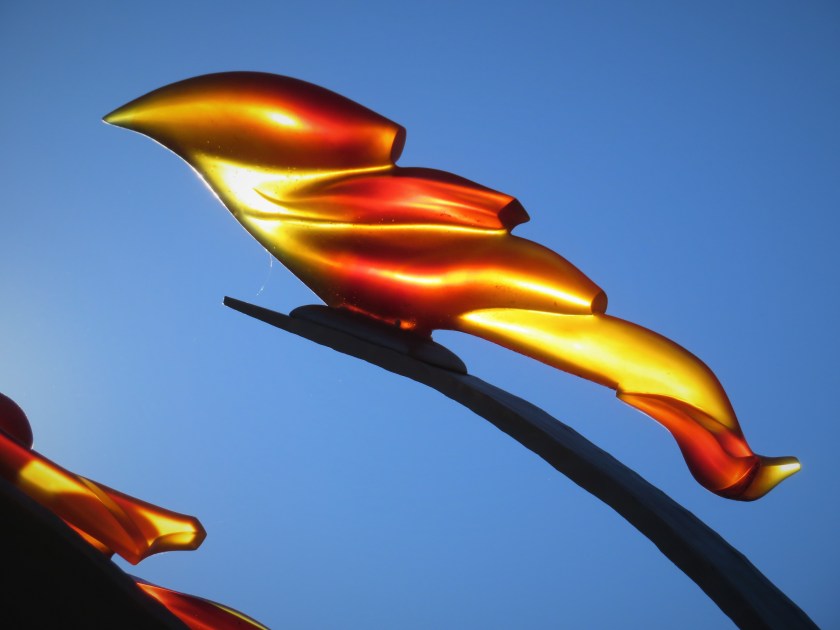
When the sky is cloudless, the sun begins to peek above the tree line and lights the sculpted monochromatic red-brown forms as if they were candles. They glow with fire. A strand of spiderweb makes itself known only by razor-edged silver reflection.
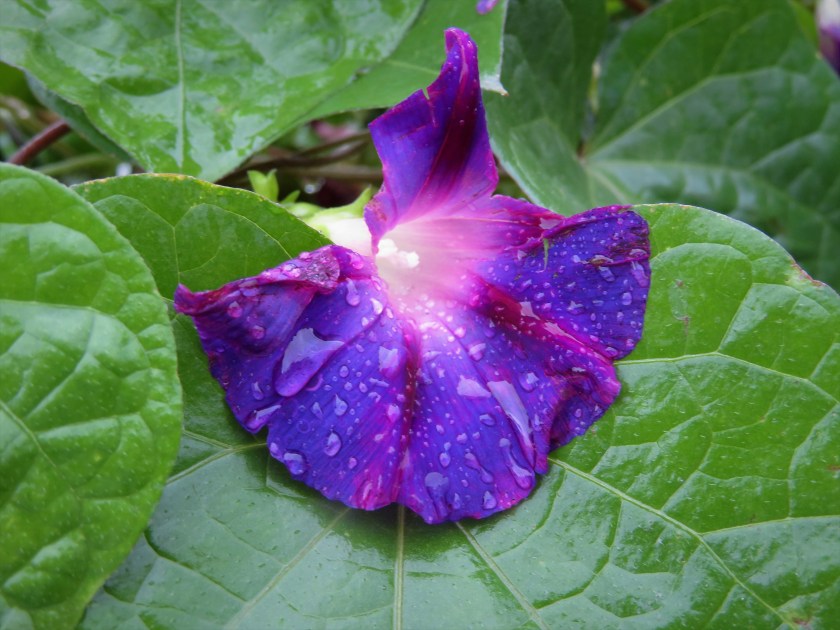
Sometimes an entire city turns gold in the rising sun. A full moon can turn a clear block of ice into silver or gold, or hover like a ghostly galleon in a tumult of waves rendered in cumulus clouds. Just a hint of sunlight can turn water into shimmery rose, or sort gray air into a rainbow. At high noon, flowers seem to be posing in a professional studio, casting everything beyond them into an illusion of pure black.
The most amazing tricks of light do not arise from the interloping sun or moon, but seem to emerge from within: impossibly dazzling, unwavering beacons even in a deluge of rain.
My husband’s out-of-the-blue diagnosis was confirmed seven years ago. It was a suffocatingly hot morning, the last Monday in June.
For weeks beforehand I had a profound and decreasingly punctuated sense of dread.
I was at the wheel of the now-retired mom van, thinking about one daughter’s upcoming high school graduation and her stresses, when I was visited with the unmistakable thought, “These worries will soon seem like nothing.”
Two. Three. Four. Five. Six. Seven weeks earlier: a dream in which I visited someone I loved in a hospital room I’d never seen. Completely still. Quiet. Sterile white. In the bed a man I assumed upon waking, distraught, had been my father, although I did not see his face.
I think Jim sensed something, too, although he did not communicate it to me in words any more than he communicates with me now by traditional means.
I realize now that he did not tell me what lay ahead until he had ruled out all other reasonable possibilities.
Don’t be too eager to ask What the gods have in mind for us, What will become of you, What will become of me, What you can read in the cards, Or spell out on the Ouija board. It’s better not to know.
Or was it?
******
For more than two decades, until that final Thursday night in June, our marriage employed a device known as the “Steph news blackout”: if something would endlessly worry me but was likely to turn out fine, or simply not worth my mental energy and tendency to catastrophize, Jim would take it upon himself to resolve it.
In tandem with the news blackouts, Jim, who would have been the first to say he was not a natural joke-teller, had an approach reminiscent of his tale of the vacationing parents:
The parents go on vacation and leave their son with his grandmother. Mom and dad call home the first night to check in; their son answers the phone and says: “The cat died.” The father, sobered, says, “You know, you could have eased us into that. The first time we called you could have said, ‘The cat’s on the roof,'” the next time, maybe ‘The cat’s on the roof and we still can’t get her down,’ and then we could have been more prepared.” “OK, dad, I understand.”
The next night, the parents call home again and ask how things are. The son answers, “Grandma’s on the roof….”
Thursday night: “I think we have to prepare ourselves for the possibility that this is a tumor.”
The surgeon, Monday, just after noon, in a windowless white room, pointing to a computer screen image of my husband’s pancreas: “This is your tumor.”
******
Our first move to a house big enough for three was to a house at the edge of acres of conservation land. To get to it one had to wind around a long driveway.
Winter was coming. Jim had some people come by the house to give estimates on plowing. I went to the door, baby in arms, to let one of them in.
When he left the house I said to Jim, “Not that one. Do not have him come back here.”
Two years later I was driving home, now with a second baby in a car seat. We were diverted by a police barricade. It was an armed standoff involving the person who, without doing anything but asking if Jim was home, had made me uncomfortable enough to tell Jim not to have him come back.
******
Days before my father died a year ago, a nurse thought to mention a certain phrase he haltingly had spoken, which would not have been particularly meaningful to me had Jim not spoken the exact same words in his hospital room days before he died. I called my older brother and suggested it might be a good time to fly out.
What do I do now with my intuition? What do I do now when I feel diffuse dread?
Atul Gawande wrote in Complications, a memoir of his surgical residency, “It is because intuition sometimes succeeds that we don’t know what to do with it. Such successes are not the result of logical thinking. But they are not the result of mere luck, either.”
I think the real danger is that I am now conditioned for the heaviest of shoes to continue to drop, horrific echoes of the once steady and reliable thunking of Jim’s size 13 shoes on the wide pine floorboards in our bedroom.
But intuition, particularly conditioned intuition, can be the enemy of hope.
It may also be illusion.
Maybe what I have thought of as intuition was actually based on observations I didn’t even know I’d made. Maybe I had seen the winces of persistent muscle strain-like pain flash across the face I knew so well. Maybe I had seen my husband hold himself differently in some infinitesimal way. Maybe I had seen micro-flashes of concern in his bright eyes and his unlined face.
Maybe I had seen or heard the first wave of tremors which would signal my father’s diagnosis with Parkinson’s Disease.
Maybe the plow guy, or even his truck, had at some level reminded me of some distant defendant I had observed in a criminal case. Maybe I’d once read something detailing crime statistics involving men with red pick-up trucks.
Ultimately I think experience is more trustworthy than intuition. (They don’t call me my office’s “institutional memory” for nothing.) Of course, a devastating run of life experiences can also be at war with hope. But I shall try to surrender to neither foreboding intuition nor scarring experience.
Yesterday I was with a dear friend who, with some trepidation, gently asked me if I knew my ring–the one Jim gave me 23 years ago and I have never taken off–was missing its center stone, a bright cobalt sapphire the identical shade of the silk dress I wore on our first date as teenagers.
I took off the ring, its center starkly bereft of its ballast, to make sure the surrounding stones would not escape as well. Almost immediately I felt the ring’s absence. A subtle divet circled the base of my ring finger.
After nearly two hours retracing steps and grid-searching waterfront docks and brick sidewalks, heart lifting and then falling at each of hundreds of pebble kernels glittering in the parboiling sun, my friend Judy found a lucky penny in the street. She held it aloft toward the sun, cast her eyes upward, and asked Jim for a little help.
I gave up hope of finding the sapphire soon thereafter.
And then, within minutes, I lifted from the ground a brilliant fragment of beveled blue, its underside clouded by a dusky silver-gray sheen from 23 years’ inattention to the thin gold prongs which held it in place until it was time to catch my attention by letting go.
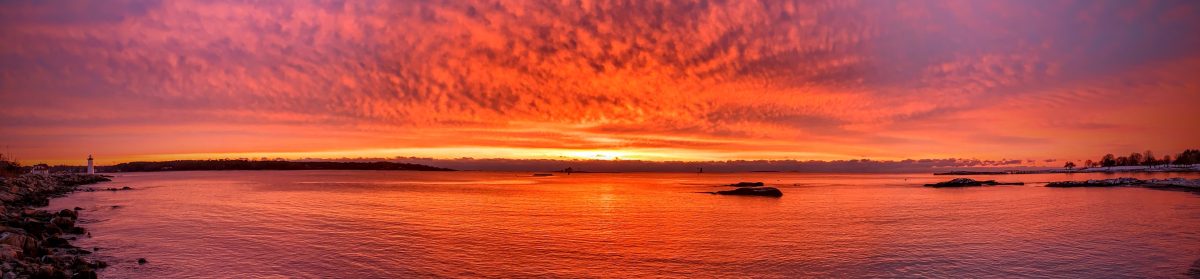
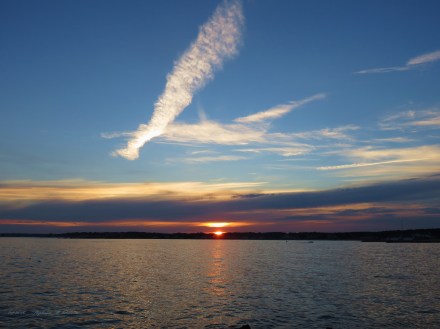
At 4:30 a.m. the waterfront view is fully saturated one day and colorless mist the next. The best hints I gather from my starting vantage point a few blocks away lie in the light: usually a patch of shimmering silvery-slate in the deep blue-black signals an unsubdued sunrise, and I quicken my pace.
It’s a little bit like Forrest Gump’s box of chocolates, or the first view of monochromatic tartan turf from inside Fenway Park: you might gather clues or intuit what your senses will tell you before you get to it, but until you do it’s never a sure thing.
I took this shot before the morning light last week before travelling several hundred miles for my younger daughter’s college graduation.
My little girl. I dropped her off at college and when it was time to say goodbye watched her twirl around and dance away in a swirling aubergine skirt, knowing she was “alright as she left” her home port.
Ten hours later, driving back to a truly unoccupied house that had seemed empty when it was inhabited by a family of only five, I was lost in an industrial park in Connecticut and found the CD my husband had somehow arranged for me to find two-and-a-half years after he died, popping it in to play and knowing only that he had selected for me John Hiatt songs from an enormous ouvre.
Before leaving home I asked my youngest if I should bring anything–did she want me to bring the necklace her father gave her for her birthday, just three weeks before he died? On a delicate silver chain is a ruby–her primary school color, and a shade not unlike her long, curly hair–surrounded by small diamonds, a treasure she let me keep in a safe place despite knowing of my tendency to forget where I have secreted such things.
She did, and I brought it for her to wear.
When we arrived, my now young adult youngest child met us at the airport, smoothly executing a parallel parking maneuver I still can’t pull off. She whisked us to her apartment and commencement eve’s blizzard of friends and activity.
A university her father did not know she would attend. A boyfriend of four years whom he never met. A city he had never visited. Friends whom he would have been so delighted to see supporting her.
After deftly reparking the car I had left egregiously unmoored from the curb, my graduate-to-be walked ahead of me in a flowing, bright printed dress, part of a wardrobe I’d never seen. I recognized the shoes, heels with an intricate cut-out design which we’d bought for her first birthday without her dad. We’d traveled together to Vermont, where the six of us had often spent her winter birthday, and I’d trudged aimlessly in an uncharacteristically muddy early March, hearing a little girl happily calling out “daddy” from a bunny slope.
While we were together I saw my daughters exchange glances quite a few times, at more than one restaurant, before gently reminding me that I kept asking for tables for one more person than was to be dining with us.
Only one of us does not have a major transition going on–new homes and jobs and graduate schools, and all their attendant and considerable hopes and stresses.
We can’t know exactly how all of these changes will work out, and while it may not be wise to steer too hard a-starboard, keep walking ahead of me. Someday I may catch up.
A gathering Nor’easter announced itself in enveloping unsettling gray, a shadow that abruptly settled over the landscape. It swallowed the sun before it could emerge in a sliver on the horizon. It nullified the morning.
Eventually light tiptoes back in, almost always defined by shadow. Today dollops of sunlight made their way through tree cover and splashed on the icy blue-gray sheen atop a foot-and-a-half of fresh snow. Bright oblong dots formed a jaunty path, as if to guide an unseen deer.
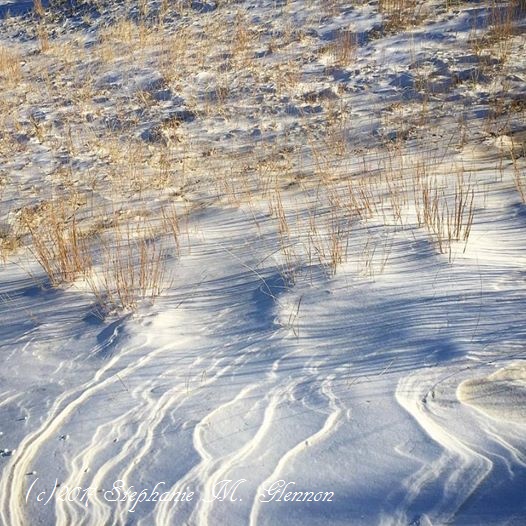
Away from the woods, among abiding dunes, high winds transformed snow into gentle waves cross-hatched with exquisite etchings of sea-grass shadows.





 Love in the Spaces