
In Spite of Spirit, In Spirit of Spite

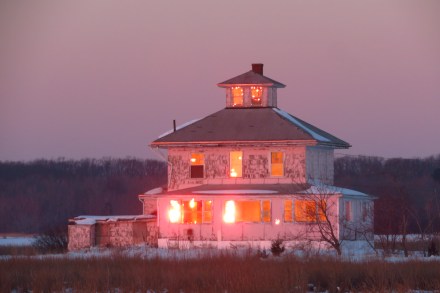
In Newbury, Massachusetts, a lone house stands only a few bubbles short of round on the giving surface of acres of marshland.

In daylight’s glare the exterior is a Pepto pink not found in nature.  Decades of gusting winds with nothing else man-made to stand in their way have aged it less than gracefully, peeling striations away to a jaundiced layer of naked wood.

I had passed by this house for years, but it was not until last year that someone described it to me as a “spite house.”

Now every time I see it I can think of nothing else.

An oxymoron: a gift of spite.  Like sending black roses, or purchasing a roach in an ex’s name to be fed to a meerkat for Valentine’s Day.

It may be that one should never look a gift horse–or house–in the mouth, but the lingering story of this bright pink edifice’s creation is one of malice.

It is said that in the mid-1920s, a divorcing lawyer agreed to build his soon-to-be ex-wife an exact duplicate of their downtown New England home.  He reportedly availed himself of what, in legalese, comprised a contractual “gotcha” in the absence of a term (here, location).  In 1925 his former spouse found herself the owner of this unusable twin, in a desolate location so unfit for human habitation that its pristine pipes could access only salt water, the better to continue malevolent mockery of the marriage’s corrosion.

Salt marsh in the wound.

My own work involves people who have committed violent felonies, yet even I had to pause and marvel at the concept of building something–and I wince at the word “building,” because it embodies creation, an inherent affirmative and additive–for the very purpose of spite.

It seems a betrayal of human expectations and decency, particularly if the back story here is true: that someone could stir the embers of a human connection that began in love and turn them into a “gift” of hate.

I am stymied by the kind of person who would expend assets and energy not in a burst of  creating–or even in an off-the-cuff emotional release of tearing something down–but in twisting something so far from its purpose.  A home as hate, not hearth.  It seems several steps into an abyss beyond neglect, or even retribution.

But I am somewhat heartened not to have encountered anyone who remembers the name of the villain in this story.  He seems to have evaporated but for the community’s collective memory of his misbegotten treatment of a fellow traveler in this world (and that it was an attorney who, as it were, did the deed).

Nearly a century later no one pays any heed to the original marital home, or seems even to know if it still stands, while the orphaned pink house remains tenderly cared for notwithstanding the physical disrepair that attends its inaccessibility.  There remains collective support of a symbol of the person who found herself so abandoned and alone.  At least one society is dedicated to the house’s preservation, and pink stickers of support abound.  Children leave hand-made Valentines fluttering by its worn front post.  Snowy owls protectively cast their golden eyes from its roof.

When the rising sun completes its winter rotation, it bathes the house in such sublime bright orange-gold that one cannot focus on its imperfections, much less its poisonous origin.

The house is no longer a monument to spite; it is more even than a single house, just as Virginia Wolff’s lighthouse was more than a lighthouse:”For nothing was simply one thing.” The lighthouse was not just a yellow beacon; it also was “true.”

The other pink house is true, too.  A thing of enduring beauty and imagination, a memorial to the person whom it was designed to isolate.  A symbol of one man’s unkindness alchemized into the kindness of strangers.
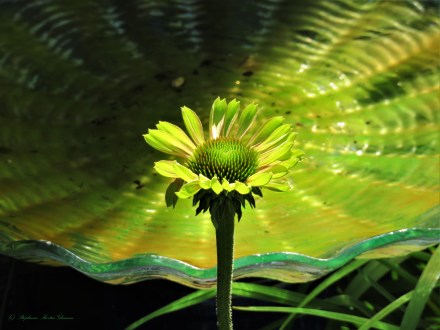
Ringed Round by Green

“If I could strip a sunflower bare to its bare soul,
I would rebuild it:
Green inside of green, ringed round by green.
There’d be nothing but new flowers anymore.
Absolute Christmas.”
Donald Revell’s poem of never-ending green, the “furnace of” an emerald eye, is titled “Death.”
I had always thought of black as the color of death, and of green as occupying the opposite end of the metaphor spectrum: the ephemeral lime green of incipient spring flower petals before alchemy renders them in magenta; crocus leaves’ broad, flat matte green, thirstily reaching through fall debris in search of stormy April skies; winter’s verdant evergreen perfume.  Jim’s color.  My own mint green eyes, encircled in teal-tinged steel blue, gifted me by my father before the furnace took him, too.
Green eyes open, studying the horizon, crying in the rain, not heavy-lidded in pain or closed in death.
In Revell’s poem, green eyes are not windows to one person’s soul, but the soul itself–a collective being of its own, holding the dead and the living, children never born to murdered children who did not grow old enough to bring them into this world.
Here closed eyes offer infinite sight.
One flower’s dismantling makes perpetual flowering possible.
Death is life and rebirth.
Black is green.
Green is never gone.

Blindside

The title came first.

I had something else entirely in mind when I arrived on my own blog in the wee hours of this morning to find a season’s worth of recent posts inexplicably wiped off the face of the internet.

They hadn’t just disappeared into the ether, but all previous drafts (but for one weak early one) had evaporated, never to be reconstituted.  I have no idea how that happened; it’s never happened to me before.

I couldn’t truly rewrite a post any more than I could recreate a quilt, or ever fully repair my bruised heart.  The only things I can replay in vivid photographic detail are technicolor memories of human connections.  Some of them are glorious, some quotidian, some so terrible thy hover beyond the limits of language.  As we grieve we shift the balance among them.

It’s impossible to entirely rebuild something that emanates from your heart and mind, to which dimension and nuance is added by revisiting and reevaluating.  Even something as simple as a blog post.

Were I to even have the heart to try, I think I would re-write tightly and tentatively.  I might wonder if the words now were as apt as I thought, whether even the experiences I wrote about were, after all, what they seemed when I first wrote it.

A college classmate wrote “The Blind Side,”   which I only just realized has an extended title: “Evolution of a Game.”

I’ll get back to that.

“The play is now 3.5 seconds old,” he writes, describing an infamous football game that resulted in a grisly on-camera injury.  “Until this moment it has been defined by what the quarterback can see.  Now it — and he — is at the mercy of what he can’t see.”

Anyone who has experienced reactive depression, or I suppose life itself, will understand the power of momentum that gathers out of your sight before you find yourself with the wind knocked out of you.

“Surprise me,” I or one of the children would say.

“Pleasantly, or unpleasantly?” their father would reply with a twinkle, and the infinitesimal crinkle of a winking eye, though he would never grow old enough to display what would have been gloriously earned laugh lines.   

And some of us are far more susceptible to the blindside than others.

An even, “That’s disappointing,”  as Jim raised his eyes to the surgeon who had handed him a report on his tumor’s invasive offshoots, while my own healthy body and heart crumbled.    

It’s been very close to eight years since my husband died.

At about the two-year mark, I met someone who had lost a sibling to cancer at the same young age and very close to the same time.  If I’d written about this just four days ago an entirely different story would have been preserved in amber, about the person I considered my best post-widowhood friend through all those years.

As Edward Gorey once wrote, “Yesterday I did not know that today it would be raining.”

But after nearly six years, deep into an exceptionally stressful winter, which anyone who knows me must know swaddles my soul in degrees of icy darkness, I found out–through a single flipping email (terse, yet encompassing abuse of the adverbial form; anyone who knows me is aware that’s going to be poison icing on the cake)–that, at best, things were not as they had seemed.  That maybe I was even part of the “evolution of a game.”

So that can’t be reworked, rewritten, rebuilt.

Maybe I’ll start on those missing posts instead.

Warp and Weft

Imperfect Reflections (c) SMG 2018

Movers could have unfurled the enormous Persian rug in one of two ways.

Once spread out, it fills more square feet than did our entire first apartment as newlywed grad students.

A symmetrical design falls away in layers from a central medallion reminiscent of a quavering diamond, outlined with both gentle waves and angled peaks.  The rug is distinctly in my husband Jim’s calm color palette: gentle golds, russets, and moss greens, with a smattering of milky blue. (I find that I gravitate to riots of color, at least when I surface from grief to come up for air.)

Over the years I have, heel-to-toe, paced these never-ending lines while preparing to argue cases, waiting interminably as my customer service calls were “escalated” up the line, and giving and receiving both good and Very Bad news.

After the not inconsiderable task of unfurling the rug in my newest home–now three full cities and one state distant from its original tenure with us–I saw that the movers’ serendipitous choice of where to deposit it has laid bare its deep flaws.

Some might have discarded this rug many moves ago.

Had it faced the other way, its mutilated corner would have been hidden from view underneath the cream-colored couch (which, of far more recent vintage than the rug, bears only a minor flaw: a sprinkling of puppy teeth marks) .

But now the abraded corner has been splayed for all to see, if they are in the habit of periodically looking down to see where they are going.

Patches of hand-knotted wool have entirely worn away; fringe has thinned to weary threads.

The selvage cannot be salvaged.

The manner of injury was inadvertent; the cause was over-watering (of a potted ficus that towered over me).

The venue was a more modern home, the sun-soaked slightly sunken living room, to be exact.

My husband made very few mistakes in his all too short years, especially when it came to living creatures.  But boy, did he over-water that plant.

The water, in turn, seeped through drainage holes in its large clay pot, and into a significant swath of the perfect new rug that was then our most expensive purchase in our years of marriage.

We did not actually notice this until we were almost ready to roll the rug up for a move to the old house he loved so much, where his earthly possessions would remain for me to tend to when we moved the next time, and the next.

The damaged portion is now a tattered island moored to the mainland by its underside, where it seems Jim fashioned a large rectangular dressing from carefully cut adhesive strips of silt-colored paper.

Over the years the adhesive hold has become more tenuous; fissures have developed, revealing ragged shallow ridges of scored, carmelized once-sticky paper which poke through the surface like baleen teeth.

The rug’s measurements are the same, but  it is off kilter.  Perfect symmetry is a thing of the past. It’s as if only this portion of the rug has aged–badly, in the way too severe a shock robs a body of its power to entirely heal.

Even in the dark, this damage would make itself known by the gentle crinkling sound the paper dressing still makes when a foot or paw treads even lightly upon it.

I have left the rug that way, not simply because it is far too weighty for me to move.  It is right at my home’s threshold; if you enter and simply glance down you will see it, cross over its threadbare glory, and perhaps contemplate its story.

It was pristine when it came to us.  Jim purchased it after careful appraisal, and with some consternation about the price–more than we had paid for any car we’d purchased, and four times the entire semester’s cash he’d carried as a college freshman–in the dog days of  August.  Our first baby was in my arms and a welcome breeze came in.

For awhile the rug was the only furnishing in our living room.  In the only shaded corner was a large stone fireplace where we posed our perfect baby boy in the tiny Santa suit his Aunt Liz gave him before he was born.

A year later, I sat on it in a room still bereft of furniture , and baby Sam gently patted the belly under which his brother dwelt.

After we had next moved, by then with three preschoolers, we returned to the empty  house for one last visit.  Our smiling sons sat on the two low wooden steps into the living room, where our seated toddler daughter’s image was reflected in the gleaming wood floor.

I have noticed, only in retrospect, that once we became parents Jim became more of a caretaker to all living, growing things.   He brought the ficus home shortly after we brought home our firstborn, and surrounded our homes with bird feeders which he carefully maintained.  Over the years he planted and maintained flowers and bushes and trees and grew berries and vegetables he readily sacrificed to wildlife visitors, rather than safeguarding in a way that might endanger critters emerging from surrounding woods. He even enlisted and supervised less complex organisms, tapping maple syrup, tending to sourdough bread starter, and brewing beer.

He maintained bird feeder cities, tending more meticulously to their culinary sensibilities than I ever was capable of when attempting to sate our humans and beagles.

Perhaps it is needless to say I am not such a fan of perfection.  Maybe it’s just a chicken and egg proposition, as I have never been close to that mark.

I now have another, far smaller rug that appears to be perfectly symmetrical.  I acquired this magic Mughal carpet in Uttar Pradesh, where one of my daughters and I saw such rugs being hand-made.  Unlike the damaged rug at my home’s threshold, its asymmetry is well hidden but complete: due to the arrangement of its warp and weft, from one side it is deep sapphire, and from the other a steel blue-gray.

Little in life satisfies the human impulse to see and seek beauty in perfect symmetry.  And among what is worth holding on to, few things are unscarred.